By KeystoneIQ Founder · 10 min read · Published May 24, 2026 · Updated October 4, 2026
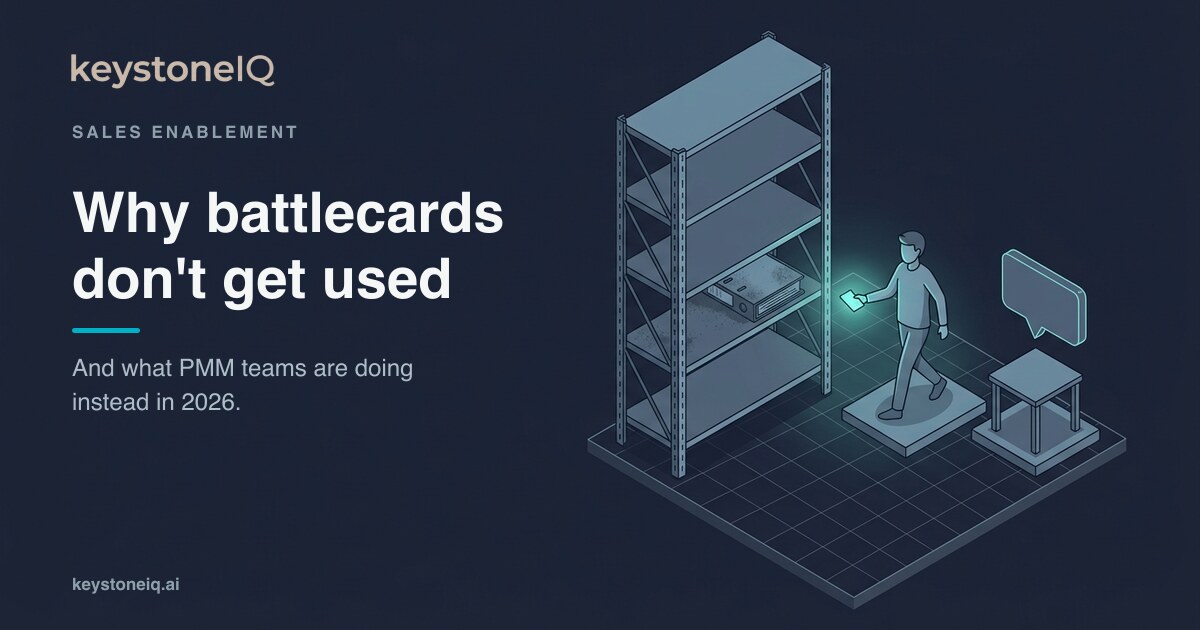
Ask PMMs why their battlecards go unread and the answer is blunt. In a September 2025 r/ProductMarketing thread titled "What's the secret to a sales battlecard that actually gets used?", one commenter told the PMM asking that the problem was not them: reps simply do not read battlecards, so run trainings where reps hear the lines out loud instead. [1] If you have built battlecards, you know the feeling. The useful questions are why it happens, and what Frontier PMM and GTM teams are changing so their competitive intel gets used.
Move from a card reps don't open to a feed in the surfaces they already use
KeystoneIQ delivers competitive intel to Slack, Teams, and email, posts briefs to HubSpot and Salesforce deals once you turn on CRM write-back, and flags competitor mentions in your Gong calls. Key claims cited and dated. Start the 14-day trial, no card required.
Start free trialThe honest read: PMMs know their battlecards go unread
Read the r/ProductMarketing threads on the topic from the past year and the pattern repeats: PMMs spend weeks building, reps glance and move on. In the same September 2025 thread, one PMM described the other side of it:
"I spend weeks talking to product, digging through competitive intel, and crafting what I think is the perfect, concise battlecard for a new feature. And then... crickets. It sits in a shared drive, rarely gets opened, and sales reps still ping me with the exact questions the battlecard answers." Educational-Wish4061, r/ProductMarketing, September 2025 [1]
A December 2025 thread, "Do battlecards actually work, or are they just busywork?", made the same complaint from the PMM side. In our words, summarizing one reply: sales teams keep asking for battlecards, no version is ever good enough, the one situation they needed is always missing, and the whole exercise eats a large share of the PMM's time. [2]
And a January 2026 post summed up the structural problem:
"We have a Slack channel for competitor updates. Someone posts a funding announcement or new feature. Everyone reacts with eye emoji. Nothing changes." Outrageous-Treat3083, r/ProductMarketing, January 2026 [3]
This is not mainly a training problem. It is a structural mismatch between the way battlecards get made (one long doc, quarterly, in PMM voice, in a wiki) and the way reps actually work (one line, ambient, in their own voice, in Salesforce or Slack). PMMs who have stopped trying to fix the doc and started fixing the structure are the ones whose intel actually changes rep behavior.
Four structural reasons the doc model breaks
1. The card is stale before the rep opens it
One PMM's own accounting puts a card at about 16 hours of work. Multiply by 5 competitors. That math forces a quarterly refresh. Competitor pricing changes mid-quarter. The first time a rep walks into a call quoting your card and the prospect corrects them on price, the rep stops trusting the document. From then on, the card sits unopened.
2. The card lives where the rep does not
Most battlecards live in Notion, Google Drive, Confluence, or a sales enablement tool reps rarely log into. Reps live in Salesforce, HubSpot, Slack, and their call recorder. A card that makes the rep leave the deal record for a wiki page is a card the rep does not open. A card that shows up on the deal record, or in the Slack channel where the deal is discussed, gets seen.
3. The card is written in PMM voice, not rep voice
"Key differentiators include unified workflow architecture" is something a PMM writes. "Most of the teams we win in your range tell us the difference is one shared timeline instead of three siloed tools" is something a rep can say out loud on a call. The first one gets skimmed and ignored. The second one gets repeated, sometimes word-for-word, in the next demo. PMMs who care about adoption write the line the rep will say, not the differentiator that is technically correct.
4. The card is longer than the call has room for
Many battlecards grow into multi-page documents: SWOT, feature comparison, objection-handling table, trap questions, win stories, pricing analysis. Reps fit competitive prep between other work. They are not going to read several pages. They will read one line, and skim a few more if those are easy to find. The card that respects that attention budget gets used. The card that ignores it gets a polite scroll.
The 2026 shift: four moves PMMs are making instead
In the public discussion and in our own experience, PMMs whose competitive intel moves rep behavior tend to describe four structural shifts. None of them require a new template. All of them require changing what the artifact is and where it lives.
From quarterly doc to continuous feed
The card still exists. It is just no longer the input. The input is a continuously captured stream of pricing diffs, product changelog entries, exec hires, funding events, and Gong call mentions, each one dated and sourced. The card is what gets rendered on top, on demand. The PMM owns the framing. The system owns the freshness.
This is the biggest shift because it changes the underlying physics. A card built on a quarterly snapshot starts aging the day it ships. A card regenerated from a live stream stays far closer to current. The scramble when sales or leadership needs a competitive answer today, which we covered in The Fast Battlecard, mostly stops once this shift is in place.
From PMM voice to rep voice
This is the lowest-effort, highest-impact change on the list. Stop writing differentiator bullets. Start writing the line the rep will actually say out loud. If you cannot picture an AE reading the line off your card and saying it on a call without rewording it, rewrite it.
The test we use: read your line out loud. If it sounds like marketing, it is. If it sounds like a thoughtful person on a Zoom call, it will get used.
The fastest way to keep a card in rep voice is to write down what nobody should ever say: no promising roadmap, no knocking the competitor, no naming customers without approval. In KeystoneIQ that list is Your stance (editable on Starter and up). Battlecards show it at the top, and briefs are written to follow it.
From wiki page to in-the-deal surfaces
The wiki page is the wrong surface. Reps will not navigate to it. The right surfaces are the ones reps already work in: a card or note on the Salesforce or HubSpot opportunity, a Slack message when something about the competitor changes, a short brief attached to the deal. The card meets the rep where they are.
This is the shift that requires tooling, because no static doc can be in several places at once and stay current in all of them.
From one long card to one short line per moment
The five-page card optimizes for completeness. Reps optimize for "what do I say next." Optimize for the rep's unit of work, not the PMM's. The same competitor needs different framing at first demo (positional), at pricing (defensible value), at technical eval (where you genuinely differ), and at close (de-risking the switch). Four short artifacts beat one long one, because each one fits the moment.
Practical version: take your existing 5-page card and rewrite it as four one-page (or one-paragraph) artifacts mapped to deal stages. Reps will use the staged versions and ignore the long one within a quarter.
What this looks like in week-one of trying it
If you want to test the shift without rebuilding everything, here is a week-long experiment worth running:
- Day 1. Pick your top one competitor. Take your existing battlecard. Cut everything that is not the pricing, the newest shipped capability, or the current narrative. Date-stamp the three remaining facts.
- Day 2. For each of those three facts, write one rep-voice line. Read each line out loud. If it sounds like marketing, rewrite it.
- Day 3. Add one watch-out trap (the one question the rep does not know they should be ready for) and one objection-handling line.
- Day 4. Put the result inside the surface reps already use. If you have CRM custom fields, add it there. If not, drop it as a pinned Slack message in the deal-room channel. Do not put it in Notion.
- Day 5 to 7. Track who opens it. If usage on the new format is well above the wiki version, you have proof. Scale it to your next two competitors.
The reason this works is that you have not changed how much CI work you do. You have changed what the output of that work looks like and where it lives. Adoption is the variable that moves.
See what a rep-ready card looks like
The sample battlecard on KeystoneIQ opens with the team's never-say rules, then differentiators, deal-ready talking points, and objection handlers. Signals are dated and key claims link to their source.
View a sample battlecardWhy this is now a tooling question, not a discipline question
Two of the four shifts above (rep voice and one-line-per-moment) are pure craft. Any PMM can do them in a week. The other two (continuous feed and in-the-deal surfaces) are structural and require something running in the background. This is why we built KeystoneIQ the way we did.
- Continuous capture. From Starter, KIQ re-checks your primary competitors' changelogs and tracks news, funding events, job postings, and competitor mentions in your synced Gong calls. Growth and Pro add pricing-page alerts and executive-change alerts. New signals land dated and sourced.
- Cited claims. Key claims in a KIQ brief carry a ClaimChip citation. Reps can click a cited fact and open its source. Rebuilds the trust that stale cards burn.
- In-the-deal surfaces. Deal briefs and a HubSpot deal card, from Starter. Add a brief to a HubSpot or Salesforce deal (Starter and up) once you turn on the opt-in CRM write-back switch. A Salesforce sidebar on Pro. Weekly briefs and competitor change alerts in Slack, Teams, or email, from Starter.
- Per-competitor cards generated on top of the feed. On Growth and Pro, refreshed weekly from new briefs. The card is a view, not the source of truth.
The PMM still owns the framing, the rep voice, and the call on which few facts out of many make the card. KIQ owns the continuous capture and the surface delivery. That division is the actual fix for "battlecards don't get used."
The 14-day evaluation
If you want to run the experiment with the tooling in place rather than stitching it yourself, here is a 14-day version:
- Day 1. Start a KIQ Growth trial (14 days, no card). Add your top three competitors. Your first brief lands in minutes.
- Day 7. Compare the auto-generated card to your existing one. Take the rep-voice lines from KIQ, push them into your CRM custom field or Slack deal channel.
- Day 14. Count opens, count references in calls, count "what do we have on X" pings you did not have to respond to. Decide whether the math works.
Run the experiment with a continuous-capture layer underneath
14-day Growth trial. No credit card. Per-competitor cards, cited and dated, plus briefs delivered to Slack, Teams, or email.
Start free trialFrequently asked questions
Why don't sales reps use battlecards?
Four structural reasons: the card goes stale because a manual refresh is expensive, so it happens quarterly at best; it lives in Notion or a shared drive instead of the CRM or Slack where reps work; it is written in PMM voice rather than lines a rep can say out loud; and it is too long to read between meetings. Reps stop opening it after the first time the pricing turns out to be wrong.
What replaces a static sales battlecard in 2026?
Four shifts: from a quarterly document to a continuous feed of dated, sourced competitor signals; from PMM voice to rep voice; from a wiki page to the surfaces reps already use, such as the CRM opportunity and Slack; and from one long card to one short line per stage of the deal. The card still exists, but as a view on top of fresh signal rather than a hand-written document.
How do you get sales reps to actually read competitive intel?
Stop asking them to go and read it. Put the intel where the rep already works, on the open opportunity in the CRM or in Slack. Replace the long page with one short line per moment in the deal. Date-stamp every claim so reps know what is still current.
Is the answer just better battlecard templates?
Not on its own. A template fixes structure and length, which helps. But a well-formatted card still ages out, still lives in a wiki reps do not open, and can still be written in PMM voice. Pair the template with continuous capture and delivery into the tools reps already use.
Sources
- Smooth-Assistant-309 and Educational-Wish4061, r/ProductMarketing, "What's the secret to a sales battlecard that actually gets used?", September 2025.
- ShaiDorsai, r/ProductMarketing, "(B2B SaaS) Do battlecards actually work, or are they just busywork?", December 2025.
- Outrageous-Treat3083, r/ProductMarketing, "(B2B SaaS) Competitive intelligence is mostly theater", January 2026.
Reddit quotations are reproduced verbatim (paraphrases are marked as our words) under fair use for journalistic and educational commentary, with attribution to author handles and source threads. Thread URLs were valid at time of publication; Reddit posts can be edited or removed by their authors. KeystoneIQ pricing and product details reflect plans as of October 2026 and are subject to change; see keystoneiq.ai/pricing for current pricing.
See KeystoneIQ in your stack
Built for Frontier PMM and GTM teams. No credit card, no annual contract. Your next brief in minutes, not weekends.
Start free, no credit card