By KeystoneIQ Founder · 8 min read · Published May 25, 2026 · Updated October 4, 2026
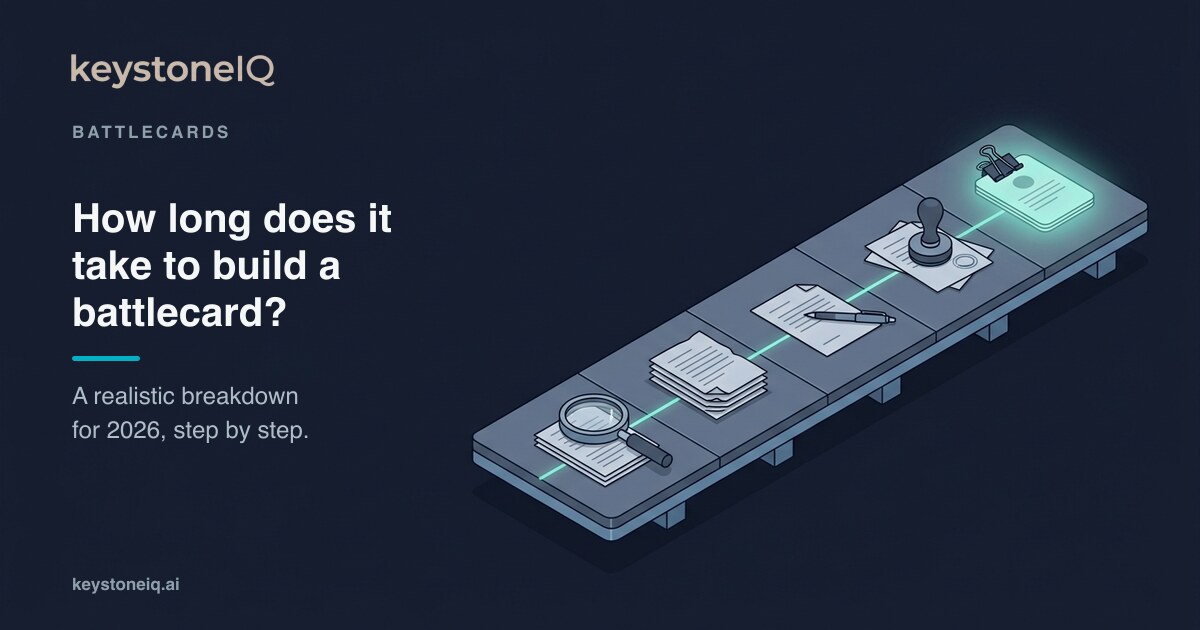
There is no industry benchmark for how long a battlecard takes, and anyone quoting you a precise average is guessing. What does exist is a public practitioner log of about 16 hours for a single card, and a clear picture of where that time goes. This post walks through the four steps behind a card that reps actually trust, the factors that make one card take far longer than another, and how to time your own process so you can decide what to fix.
TL;DR
- The one public data point: a PMM on r/ProductMarketing logged about 16 hours for one card, most of it research.
- Four steps: research, synthesis, drafting, review. Research is the most mechanical; synthesis is the most valuable.
- What makes a card slow: gated pricing, a noisy review footprint, no template, rep-voice rewriting, and slow reviewers.
- The hidden cost is the refresh. Multiply your hours per card by competitors and refreshes per year before you commit to a cadence.
- Time your own next card. Your log is a better benchmark than anyone's average, including ours.
The one real data point
The most concrete public figure we have found is a practitioner's own time log in a 2025 r/ProductMarketing thread titled "Building battlecards from scratch, How long would it take you?":
"Total research time, around 10 hours per battle card. Then I'll sit down and use a template to build the card. Usually this takes about 4 hours between 2 rounds of edits. Total time including planning is about 16 hours for a single battle card." Live-Ball-1627, r/ProductMarketing, March 2025 [1]
It is one person's log, not a survey, so treat it as a reference point rather than a norm. But its shape is the useful part: most of the time went into research, before a single line of the card was written.
Vendor case studies point at the same cost from the other end. Klue's Blackbaud case study reports a CI lead saving "~10 hours per week" and a "28% increase in win rate" against top competitors after automating the capture-and-maintenance layer (re-checked October 4, 2026).[2] That is weekly time across a whole portfolio, not time per card, so the two numbers do not compare directly. Both say the same thing, though: the hours live in the manual research and refresh behind every card.
The four steps behind a battlecard
Every card that holds up on a live call goes through the same four steps, whether one person does them in a day or a team spreads them over a week.
Step 1: Research
Research is gathering, and it is the step that grows fastest with the number of sources. For a typical B2B competitor you are pulling from:
- The pricing page. Quick if it is published. Slow if it is gated and you have to triangulate from G2 reviews, marketplace listings, and forum threads.
- Product surface area. The changelog, product blog, public roadmap if there is one, and recent feature announcements.
- Marketing narrative. What is on the homepage right now, the last few blog posts, and what the CEO is saying on LinkedIn.
- Hires and exec moves. Recent job postings and leadership changes. Sales leadership hires can signal an enterprise push; PMM hires can signal a positioning change.
- Voice of the customer. G2 and TrustRadius reviews, Reddit threads, and your own sales calls where the competitor came up. Usually the slowest layer, because the volume is high and most of it is noise.
- Momentum signals. For public companies, filings and earnings calls. For private ones, funding rounds and hiring volume.
None of this requires judgment yet. It is collection, and it has to be repeated every time the card is refreshed.
Step 2: Synthesis
This is the step PMMs underestimate. A research dump is not a battlecard. You have to decide:
- What is true today, and what was true six months ago and is now history?
- What changes a rep's behavior on a call, and what is interesting but not actionable?
- What is the one- or two-sentence read on this competitor that a rep can hold in their head?
- What are the traps reps fall into when this competitor comes up, and what is the line that defuses each one?
Synthesis is the highest-impact step and the one tools cannot do for you, because the call is judgment: which handful of facts out of dozens earn a place on the card. This is where a PMM with deal context beats a researcher without it.
Step 3: Drafting
Drafting produces the visible artifact: the card itself, the objection-handling table, the trap questions, the "if they say X, say Y" lines, and the formatting.
A template makes this step much faster, because the structure and line budget are already decided. Without one, formatting and consistency work can take as long as the writing. (Our free one-page battlecard template exists for exactly this reason.)
The part that most often gets skipped is the rep-voice translation. "Differentiators include unified workflow" is PMM voice. "Most of the folks we win in your range tell us the difference is one shared timeline, not three siloed tools" is rep voice. Doing that translation line by line takes real time, and in our view it is the biggest single factor in whether the card gets used.
Step 4: Review and iteration
Typically a pass with a sales lead, a pass with a product manager, a round of edits, and a final read. Your own time here is modest; the elapsed time depends on how quickly reviewers come back to you.
What makes one card take longer than another
The same four steps can take an afternoon or most of a week. These are the drivers that move it:
- Competitor type. A public, marketing-heavy enterprise competitor has a lot of surface area, but most of it is published and findable. A stealth or sales-led competitor with no public pricing is usually slower, because you are stitching signal together from indirect sources.
- Noise in the voice-of-customer layer. A competitor with thousands of reviews and active community threads takes longer to read than one with a handful.
- Whether you have a template. Without one, every card re-decides its own structure.
- How much rep-voice rewriting the draft needs. Cards written in PMM language need a second pass before reps will use them.
- Team shape. A dedicated CI analyst usually spends more time per card, but produces deeper work, with interviews and a formal win/loss program behind it. A two-person PMM team can split research from synthesis. One PMM running CI alongside launches and enablement carries every step alone.
- Whether the research is already captured. If competitor changes are logged continuously, with dates and sources, research becomes a review of what changed rather than a fresh hunt.
- Unverified AI drafts. Asking a general chatbot for a card is fast, but pricing and features still have to be checked by hand before a rep sees them. One wrong number on a call and the rep stops trusting the card.
The real cost is the refresh, not the first build
Building a card once is a project. Keeping it current is a recurring cost, and it is the reason so many cards are stale by the time a rep opens them. The arithmetic is simple:
(hours per card) × (competitors you track) × (refreshes per year) = annual hours on battlecard maintenance.
To see how fast it adds up, plug in the one public figure: if every card took the roughly 16 hours that practitioner logged, five competitors refreshed quarterly would be 5 × 16 × 4 = 320 hours a year, about 16 percent of a 2,000-hour working year. Your numbers will differ, but the multiplication is what breaks most refresh schedules. When CI runs alongside launches, messaging and enablement, those hours rarely exist, so the refresh slips.
That is how a rep ends up opening a card that is months old: pricing changed, two features shipped, and nobody had the hours to update it.
What changes if the research is already captured
The breakdown above points at the lever. Three of the four steps (synthesis, drafting, review) are judgment calls that no tool can or should take over. Research is mechanical and continuous: the pricing page, the changelog, the job postings, the sales call. Capturing those continuously, with dates and sources, turns research from a hunt into a review. We have not measured the saving across customers, so here is the direction rather than a number:
- Research becomes a review of captured changes: you flag what matters.
- Synthesis is still your judgment, but the inputs arrive sorted by recency.
- Drafting starts from cited signals in a card format, and you edit.
- Review has less ground to cover because the facts arrive with sources and a confidence label.
The hours that remain are the ones that should stay human: deciding what goes on the card and how to say it to a rep.
See what a continuously captured card looks like
Same format as the cards you build by hand, but key claims are dated and link to their source, and the signal underneath refreshes on a schedule. Battlecards are on the Growth and Pro plans.
View a sample battlecardRun the numbers on tooling
Battlecards are on the KeystoneIQ Growth plan: $399 per workspace per month, or $3,990 a year billed annually, with a 14-day trial and no card. Rather than quote you an estimate of the saving, run your own: (hours saved per card) × (competitors) × (refreshes per year) × (your fully loaded hourly cost), and set that against $3,990 a year. Time one card by hand first, as the next section suggests, so the inputs are yours.
This is not the broader case for why CI is worth a line item (we covered that in the buyer's guide). It is the narrower point that build-and-refresh time alone can justify tooling for a lean PMM team.
How to benchmark your own process
Your own log is a better benchmark than any published average. Three questions worth answering this week:
- When was the pricing on your top three competitor cards last verified? If it has been more than a month, you are exposed.
- How many hours did the last card you rebuilt actually take? Time the next one, step by step. Most people underestimate their own hours.
- What share of your cards were refreshed in the last 30 days? If it is under half, the cadence is structurally broken, and the cause is the hours-times-competitors math, not effort.
If the answers are uncomfortable, the fix is not a faster template. It is moving from a quarterly snapshot to continuous capture. We wrote a separate post on what that shift looks like.
Try it on your own competitors
Start a 14-day Growth trial, add your top three competitors, and compare the cards KeystoneIQ drafts with the ones you have today. No credit card.
Start free trialSources
- Live-Ball-1627, r/ProductMarketing, "Building battlecards from scratch, How long would it take you?", March 2025.
- Klue, "Blackbaud Boosts Competitive Win Rates Against Top Competitors by 28% with Compete Agent", re-checked October 4, 2026.
Reddit quotations are reproduced verbatim under fair use for journalistic and educational commentary, with attribution to author handles and source threads. The 16-hour figure is one practitioner's self-reported log on a public forum, not a study; the 320-hour figure is arithmetic on that single log, for illustration only. KeystoneIQ pricing reflects plans as of October 2026; see keystoneiq.ai/pricing for current pricing.
See KeystoneIQ in your stack
Built for Frontier PMM and GTM teams. No credit card, no annual contract. Your next brief in minutes, not weekends.
Start free, no credit card