By the KeystoneIQ team · 9 min read · Updated May 7, 2026
Also in this series: Klue alternatives · Crayon alternatives · Kompyte alternatives · Klue vs Crayon head-to-head
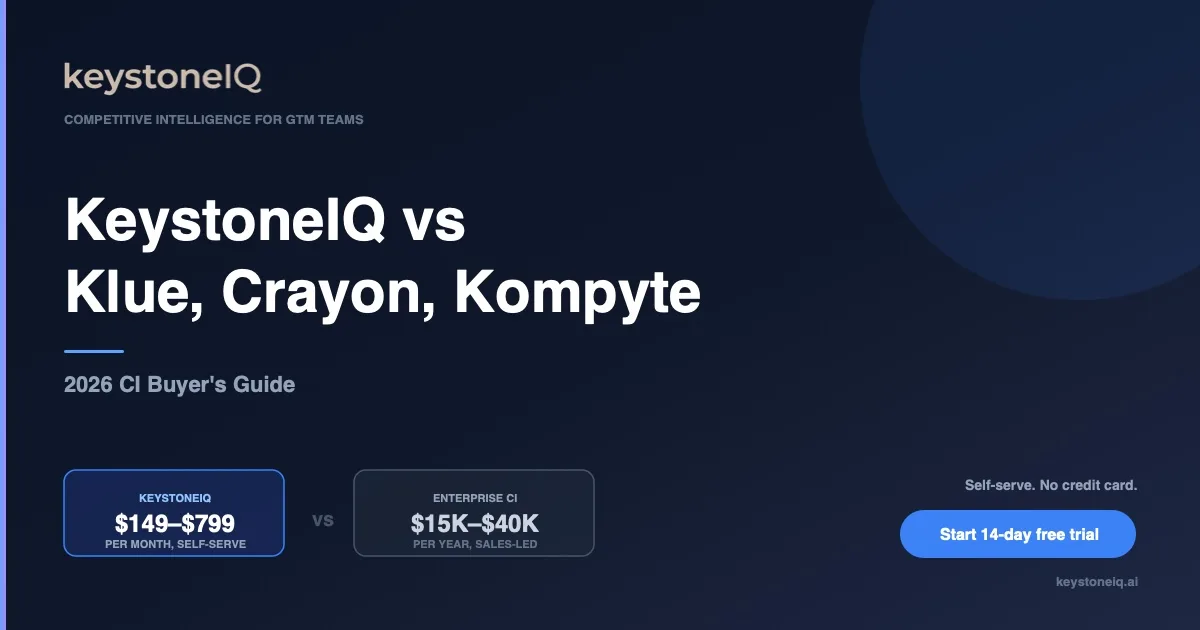
Picking a competitive intelligence platform in 2026 means choosing between two procurement realities: a sales-led $15K to $40K annual contract with Klue, Crayon, or Kompyte, or a self-serve $149 to $799 monthly subscription with KeystoneIQ. Each fits a different segment. This guide compares all four on what they actually do, where each is the right call, and the procurement reality behind the price.
Self-serve. 14-day trial. No enterprise contract.
Start a KeystoneIQ trial with full Growth-tier access. No credit card. First weekly brief in under an hour.
Start free trialTwo things have shifted the picture for buyers over the last twelve months. Klue launched its Compete Agent and reported a 28% lift in competitive win rates at Blackbaud after rollout[1]. And budgets stayed tight, which makes a $15K to $40K annual contract harder to justify for a 5 to 50-person GTM team when a self-serve alternative covers the day-to-day deal prep at a fraction of the spend.
This post compares Klue, Crayon, Kompyte, and KeystoneIQ on what each actually does as of May 2026, with citations on every comparison claim. Here is the honest framing. Klue, Crayon, and Kompyte are mature enterprise platforms built around a sales-led motion. They fit larger organizations with dedicated CI programs and the procurement bandwidth for an annual contract. KeystoneIQ is built for the smaller GTM team that wants the day-to-day CI workflows without the enterprise procurement overhead. Different segments, different motions. Not better, not worse.
What KeystoneIQ shipped at launch
The launch includes three features (on Starter and above) that cover core deal-prep workflows Klue advertises directly, with Crayon and Kompyte offering analogues across their broader enterprise offerings. None of these are claims of full feature parity. They are the workflows GTM teams use every week, now available without an enterprise procurement cycle.
Pre-call meeting briefs on every CRM-attached call
For every upcoming sales call on your team's calendar, KeystoneIQ pulls thirty days of competitor signals, joins them to the deal's CRM context (open objections, recent activity, custom fields), and writes a 30-second brief: deal context, expected objections, recommended talking points, watch-outs.
We derive upcoming meetings from your existing Salesforce Event records, HubSpot meeting engagements, and Gong scheduled calls. There is no separate Google Calendar or Outlook OAuth on top of that. If you've already connected a CRM and Gong, the meeting brief just runs.
The closest peer use case is Klue's Deal Tips, which Klue describes as deal-specific insights delivered directly to sellers[2]. Klue does not publish which pricing tier includes Deal Tips. On KeystoneIQ, this lives on Starter at $149 per month. Same workflow shape, packaged for self-serve sign-up instead of an annual contract.
Auto-flagged competitor mentions in Gong calls
KeystoneIQ scans your synced Gong calls, flags every competitor mention via Gong's Smart Trackers feature, and re-ranks each match with an LLM to drop incidental references and questions. The flagged mentions land directly on the deal page and feed the weekly brief.
Klue ships an analogous capability through its Gong integration, which "takes every call with a competitor mention, adds the number of mentions, and displays the calls with the most of them"[3]. Klue's announcement does not specify which pricing tier the Gong integration is on, or which Gong subscription level is required.
One caveat to be transparent about: Smart Trackers is not included in every Gong package, so check your plan[4]. KeystoneIQ falls back to keyword-based detection when trackers aren't available, and the in-app integration card tells you which mode is running. You don't pay extra for the integration to work either way.
Funding, M&A, and exec-move signals as their own brief row
News signals are classified into funding rounds, M&A events, exec hires, exec departures, and broader leadership-change events. They surface as a dedicated row in your weekly brief instead of buried in general news.
News-dense weeks tend to bury exec moves and funding rounds. The dedicated row keeps the highest-leverage strategic signals visible to your team without manual triage.
Where KeystoneIQ stands out
Three things KeystoneIQ does that aren't standard at our price band, and why each one matters in your week:
Cited claims on every brief
Every sentence in a KeystoneIQ brief carries a ClaimChip citation. One click and you see the source document, the timestamp, and the multi-model verification trail. Each brief also publishes a Trust Score that reflects recency, corroboration, and intra-corpus NLI checks for contradictions. We don't ship a brief without it. See a live ClaimChip on a sample brief →
This matters because a hallucinated competitor claim landing in a board deck or a sales call is expensive. Cited intelligence means your team quotes the source, not the AI.
SEC EDGAR XBRL financials and earnings-call intelligence
For public-company competitors, KeystoneIQ pulls structured XBRL financials from SEC EDGAR (revenue, gross margin, operating margin, segment growth, share count) and runs earnings-call transcripts through our intelligence layer to surface forward-looking commentary. Both are on our Pro $799 plan.
SEC EDGAR XBRL parsing is its own engineering project, and the financial-data layer is uncommon at our price band. For a CI lead briefing the C-suite on a public competitor, this is the difference between "what they say in the press release" and "what they tell investors on the earnings call."
Workspace Knowledge Graph and conversational Ask KIQ
Every signal we ingest gets entity-linked into a per-workspace Knowledge Graph. Reps and PMMs query it with Ask KIQ: streaming, multi-turn, citations on every answer. Available on our Growth $399 plan, not gated behind an enterprise contract.
What this gets you: the entire history of every competitor's moves, deals, calls, and signals becomes a queryable knowledge layer. Your CI program compounds week over week instead of starting from scratch each Monday.
See it on a sample brief
Five sample artifacts (Weekly Brief, Battlecard, Deal Risk Score, Knowledge Graph, Board Report) on the same fictional competitor pair, so you can read them as one connected workflow.
View sample reportsThe pricing comparison
Procurement matters as much as features when you're picking a CI tool, especially as mid-market budgets stay tight in 2026. Here's what each vendor publishes (and doesn't):
- Crayon doesn't publish list pricing[5]. Prospeo puts typical contracts at roughly $20K to $40K a year with entry points around $25K, and Vendr's low end is $12,700, with price driven mainly by competitors tracked. Multi-year commitments are common[6].
- Klue doesn't publish list pricing[7]. Vendr's marketplace data (106 purchases) shows a median of about $30K a year and a typical range of $16K to $60K; PricingNow estimates $16K to $40K for a 10-user deployment[8]. Klue's own comparison page acknowledges the $15K to $40K band as typical for the category[2].
- Kompyte (part of Semrush since 2022; Adobe completed its acquisition of Semrush in April 2026[9]) doesn't publish list pricing on its plans page either[10]. Three tiers (Essentials, Professional, Unlimited), all gated behind a sales conversation.
KeystoneIQ runs $149 (Starter), $399 (Growth), or $799 (Pro) per workspace per month, fully self-serve, with a 14-day Growth trial and no credit card required. Every feature in the May 2, 2026 release is on Starter or Growth. There's no enterprise add-on and no "talk to sales" gate.
KeystoneIQ’s top tier is $799/mo, or $7,990/yr on annual billing (about 17% off), against the $15K to $40K contract bands third-party aggregators report for enterprise CI tools at the entry to mid-market band. For most mid-market GTM teams that works out to a fraction of the cost, with no procurement cycle and no multi-year lock-in — your exact savings depend on the contract you’d otherwise sign.
Try KeystoneIQ free for 14 days
Full Growth-tier access. Per-competitor battlecards, deal risk scoring, ClaimChip-cited briefs, Ask KIQ on the Knowledge Graph. No card, cancel any time.
Start free trialWhy CI is worth the line item
Competitive deals consistently underperform non-competitive deals on win rate. According to Salesmotion's 2026 win-rate benchmarks, deals with active competitor involvement close at notably lower rates than uncontested deals[11]. For a sales team running a $5M ACV pipeline at a 25% blended win rate, even a single-digit-percent lift on competitive deals is worth far more than a $9,600 annual SaaS line item.
The Klue Blackbaud case study[1] documents a 28% lift in competitive win rates after Compete Agent rollout, with the CI lead recovering ten hours a week of manual work. That is what a mature CI program can return. KeystoneIQ offers the same categories of workflow (automated briefs, deal-stage prep, win/loss patterns, cited intelligence) at mid-market pricing; measure your own lift in a trial. Whether KeystoneIQ or one of the enterprise platforms is the right call depends on the size and shape of your CI program, not on whether the basic building blocks are present.
How to run a 14-day evaluation
A trial of KeystoneIQ on Growth includes the May 2, 2026 release plus per-competitor battlecards, deal risk scoring, ClaimChip-cited briefs, and Ask KIQ on the Knowledge Graph. No card, cancel any time.
- Connect your CRM (HubSpot, Salesforce, Pipedrive, Zoho) and Gong if you have it.
- Add three to five competitors you're actively winning or losing against.
- The first weekly brief lands inside an hour. By day 14 you'll have two weekly briefs, fourteen days of signals, and enough deal-prep events to know whether KeystoneIQ pays for itself versus what you're running today.
Sources
- Klue, "Blackbaud Boosts Competitive Win Rates Against Top Competitors by 28% with Compete Agent".
- Klue, "Top Competitive Intelligence Tools for B2B Tech Teams in 2026".
- Klue, "Klue + Gong Integration: Easily Spot Competitors in Deals".
- Oliv, "Gong Smart Trackers Exposed: 7 Critical Limitations Sales Teams Discover Too Late".
- Crayon, "Pricing Inquiry".
- Prospeo, "Crayon Pricing, Reviews, Pros & Cons (2026)".
- Vendr Marketplace, "Klue Software Pricing & Plans 2026".
- PricingNow, "Klue Pricing 2026: The True TCO & Hidden Costs".
- Contify, "Kompyte Overview, Pricing, Reviews & Top Alternatives 2026".
- Kompyte, "Pricing Plans".
- Salesmotion, "Sales Win Rate: How to Calculate and Benchmark in 2026".
Information about Klue, Crayon, and Kompyte is sourced from each vendor's public marketing pages, third-party CI marketplace data, and public announcements as of May 2026. Vendor offerings, pricing, and feature parity change. Treat this as a starting point for your own evaluation and verify directly with each vendor before procurement decisions.
See KeystoneIQ in your stack
Built for modern PMM and GTM teams. No credit card, no annual contract. Your next brief in minutes, not weekends.
Start free, no credit card