On September 17, 2026, Microsoft publicly released the second edition of Becoming a Frontier Firm: Our Frontier Playbook, a 44-page account of how it is running its own AI transformation. By now it has probably reached your inbox with a one-line note from your CEO: "Thoughts?"
Most of the playbook is written for the top team. One section is written, without saying so, for product marketing. Section D, "Codify your advantage & controls," argues that AI will average away whatever makes a company distinct unless someone writes it down first. In most B2B companies, the people who hold that view of the market, the proof behind it and the lines you never cross sit in PMM.
The short version, if you have a meeting coming up:
- What section D asks for: write down your point of view, your proof, your standard for "good" and your guardrails, so AI works your way instead of the average way.
- Why it's your job: competitive content is where AI flattens a company first, because it goes straight to reps and buyers.
- What to do this week: a two-sentence take on the market and a never-do list. There's a copy-paste starter below.
KeystoneIQ is not affiliated with Microsoft. We cite the playbook as a public source; quotes are verbatim and page numbers are listed at the end.
A reply you can send your CEO today
Read it. Section D ("codify your advantage") is the part that lands on PMM. AI drafts our competitive content more every month, and without written standards it drifts to generic. This week I'll write down our take on the market and a never-do list for AI-drafted competitive content (pricing, roadmap, customer names, claims about competitors), then check our last ten AI drafts against it. I'll share what we find.
What Microsoft's Frontier Playbook says, in brief
The playbook is built around five elements (p. 3):
- A. Set business ambition and goals. Anchor AI to enterprise value. The summary line: "Efficiency is the floor. Experience, innovation, and growth are the ceiling." (p. 43)
- B. Build your diffusion engine. Buying tools is not transformation; the operating system around them is. It offers three "recipes" (Persona Acceleration, AI-Powered Process Redesign, AI-First Possibility) and three levels of AI use (p. 16, p. 23).
- C. Invest in your people. Manager role-modeling, learning in the flow of work, honesty about what is changing.
- D. Codify your advantage and controls. Turn what makes you distinct into standards AI can be measured against, and keep that intelligence inside your boundary.
- E. Safeguard your security. Guardrails for every agent, so that AI actions are "traceable, auditable, and reversible." (p. 43)
Microsoft is careful to say this is its own working method, "not to prescribe a solution nor guarantee results for others" (cover). Read it that way: a well-documented set of patterns, not a benchmark.
Why section D is a PMM problem
Section D opens with a quote from Charles Lamanna: "If you don't define what 'good' looks like, AI defaults to something generic." (p. 34) Then it makes the case plainly: "Your advantage is often tacit," and when AI enters the workflow, "that advantage is at risk of being averaged away." (p. 34)
The playbook names four dimensions to codify (p. 35). Read them as a PMM and each one is a job you already own:
| Playbook dimension (p. 35) | The question it asks | What it means in competitive and product marketing |
|---|---|---|
| Point of view | "What is your distinct thesis about where your market is going and what your customers truly value?" | Your take on the market. The framing every brief, battlecard and talk track should start from. |
| Performance | "What is the proprietary data, IP, and benchmark you have that competitors don't…" | Your proof: win/loss evidence, call notes, deal outcomes, the claims you can actually back. |
| Taste | "What does “good” look like across your most important outputs…" | What a good battlecard or competitive answer sounds like at your company. |
| Guardrails and risk | "Where will AI act autonomously, where will a human review, and where should not be deployed at all?" | Your never-do list: the claims, comparisons and promises you will not make. |
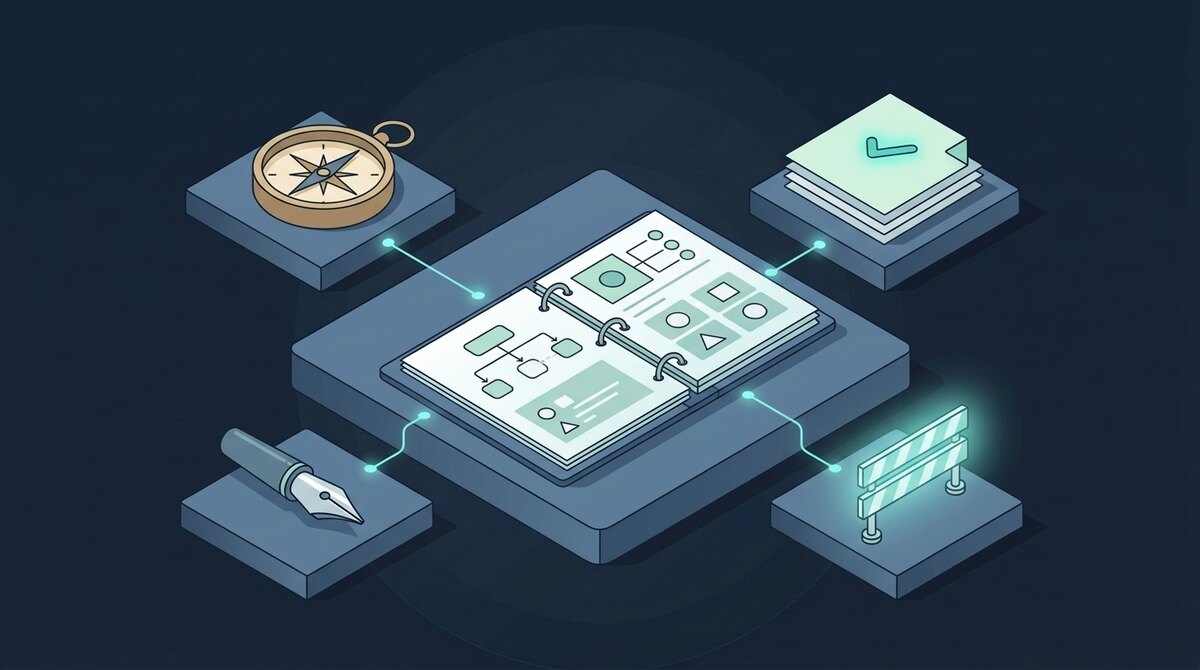
Here is why this hits product marketing first. A general-purpose model asked about your competitor will give a competent, generic answer. It does not know you never compete on price, that your legal team has not cleared naming a customer, or that your CEO decided last quarter to stop knocking a particular rival in public. The playbook's line for this is "AI must sharpen this view, not flatten it into generic insight." (p. 35) Competitive content is where flattening shows up fastest, because it goes straight to reps and straight to buyers.
AI messaging guardrails: a vendor-neutral checklist for this week
None of this needs a new tool to start. It needs a page of writing that your team agrees on.
- Write your take on the market in two sentences. Where is the category going, and what do your best customers value that others miss? If you cannot fit it in two sentences, the AI will not find it in two hundred pages of your old decks.
- Write your never-do list. Five to fifteen rules, each a single sentence starting with "Never." Common ones: never compete on price, never promise roadmap items, never name a customer without approval, never use "#1" or "best-in-class" claims, never disparage a competitor. Include the reason next to each rule so new teammates (and agents) understand the boundary rather than guess at it.
- List your proof. For each claim in your positioning, note the evidence that backs it and how recent it is. Win/loss interviews are the richest source; these 20 questions get honest answers, and you can run win/loss without a dedicated analyst. Mark the claims you cannot back yet. The playbook calls this kind of standard a private eval: "Private evals are the rubric the rest of the program is scored against." (p. 43)
- Collect three examples of "good." One battlecard section, one competitive email, one objection answer that you would happily ship. These are your taste samples. A one-page battlecard template is a useful frame for what "good" looks like at a glance.
- Decide where a human reviews. The playbook's rule of thumb is that "AI autonomy must be tuned to the stakes of each decision, not set globally." (p. 35) A weekly internal brief can run on its own. A customer-facing comparison page should not.
- Test against it. Take the last ten pieces of AI-drafted competitive content your team used and check them against steps 2 and 3. Count the misses. That count is your first, very informal eval, and it tells you whether the problem is real at your company. For a fast way to run it, use five checks for catching hallucinated claims in an AI brief.
Copy-paste starter: your never-do list
Edit the brackets, delete what doesn't fit, and keep the reasons. Paste it into the instructions of whatever AI tool your team uses, or into a shared doc reps can find.
OUR TAKE ON THE MARKET (two sentences)
[Category] is moving from [old way] to [new way]. Our best customers choose us
because [the thing they value that others miss].

NEVER DO OR SAY
1. Never compete on price. (We win on [value]; price talk shortens deals we should win on value.)
2. Never promise roadmap items. (Only what ships today. Roadmap talk becomes a contract.)
3. Never name a customer without approval. (Legal and the customer's trust.)
4. Never use "#1", "best" or "leader" claims. (We can't prove them, and buyers discount them.)
5. Never knock a competitor. (Say what we do better, with proof. Never call them "legacy".)
6. Never quote a competitor's price without a dated source. (Prices change; stale numbers cost credibility.)
7. Never [your own rule]. ([Why.])
The three levels of AI, mapped to competitive work
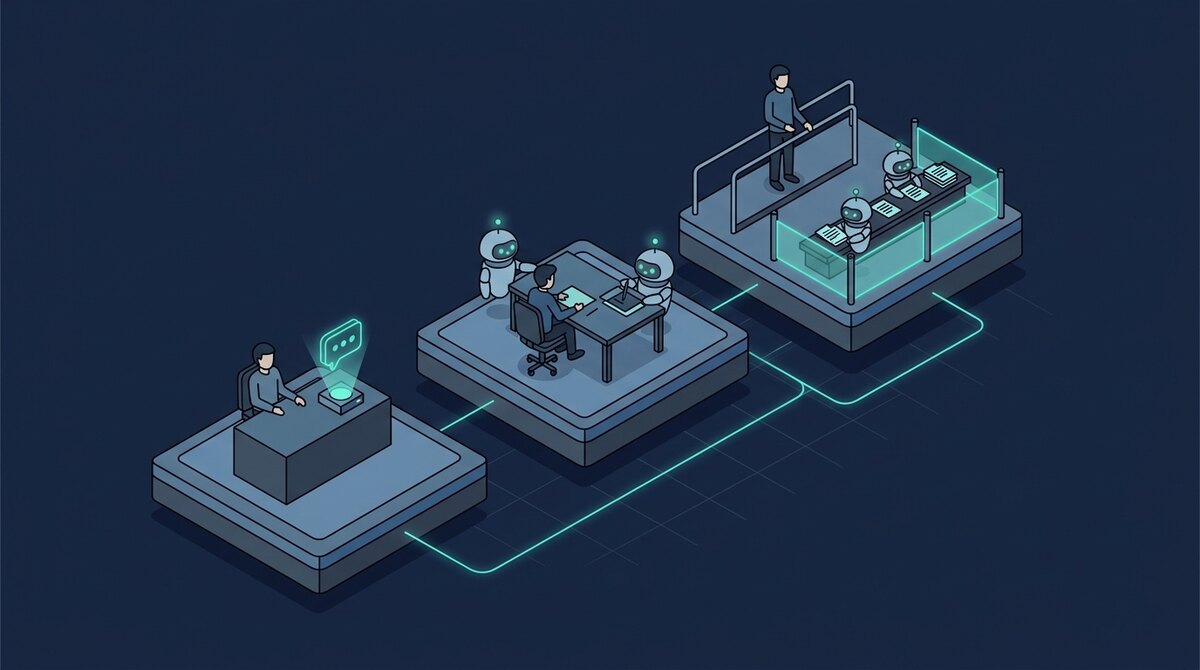
The playbook describes three levels at which AI changes work (p. 23): "Level 1: Human with assistant," "Level 2: Human-agent teams," and "Level 3: Human-led, agent-operated." Applied to competitive intelligence:
- Level 1, human with assistant. A PMM asks a chat assistant to summarize a competitor's pricing page. Useful, and only as good as the prompt and whatever the assistant finds.
- Level 2, human-agent teams. Agents watch competitor sites, collect signals and draft briefs; the PMM reviews, edits and decides what reaches the field.
- Level 3, human-led, agent-operated. Agents keep briefs and battlecards current on a schedule, and the team sets direction and checks in when something needs judgment.
The higher the level, the more your codified stance matters. At level 1 you are in the loop on every sentence. At level 3 your never-do list and your take on the market are the only parts of your judgment present when the work gets done. The playbook's advice applies here too: "Start with the role, not the tool." (p. 17) Map the moments in a PMM's week where competitive work happens before choosing what to automate.
Efficiency is the floor: tie CI to win rate and deals at risk
It is easy to sell competitive automation on hours saved. The playbook pushes past that. Its advice to leaders is blunt: "Force yourselves past efficiency." (p. 12) The example metrics it lists for customer engagement include "Win rate" and "Qualified pipeline coverage" (p. 8).
For a competitive program, that means measuring two things beyond time saved:
- Win rate in competitive deals, split by competitor, over a long enough window to mean something.
- Deals at risk, meaning open opportunities where a competitor is present and the field does not yet have a current answer.
The playbook also offers a useful diagnostic for when adoption stalls: "if input metrics are healthy but throughput metrics aren't moving in three to six months, we know we have a habit-formation problem, not a tooling problem." (p. 25) If reps open the battlecards but win rates do not move, look at what the battlecards say before buying another tool.
Inside your boundary, and independent of any one model
Section D closes with an architectural point. The intelligence in your prompts, workflows and decisions should "stay inside your boundary," and if your advantage lives in your own learning loop, "you can swap out any single model without losing what makes you distinct." (p. 34)
For a PMM, the practical version is this: keep your stance, your proof and your approved messaging in a place you control, and let assistants read from it rather than reinventing it in every chat. That is what a context layer does. The Model Context Protocol (MCP) lets Claude, Cursor and other assistants read structured, cited context from a source you choose, so the rules travel with the content no matter which model answers. We covered how that works for competitive intelligence in Competitive Intelligence Inside Claude and Cursor.
Where KeystoneIQ fits
KeystoneIQ is competitive intelligence for Frontier PMM and GTM teams: cited briefs on your main competitors, kept current every week on paid plans, with multi-model verification on Growth and Pro. On October 2, 2026 we shipped a feature built around section D's idea, called Your stance (how it works).
- Your never-do list, in one panel. One-tap rules for the most common ones (Compete on price, Promise roadmap items, Name customers without approval, Use hype or #1 claims, Knock competitors), plus up to 20 rules in total, including your own.
- Your take on the market. One or two sentences, up to 280 characters. KeystoneIQ frames its analysis around it. It is treated as framing, never as evidence.
- "Don't say this." Select any line in a brief and add it as a rule on the spot. The line is struck through, Undo is right there, and on Growth and Pro the line drops out of your battlecards right away.
- It travels. Weekly briefs, deal briefs and pre-call briefs are written to follow your stance, and Claude, Cursor or any MCP client reading your workspace receives your team's rules alongside what it reads. On Growth and Pro, Ask KIQ follows it as guidance, messaging drafts treat your rules as hard constraints, and battlecards open with a "Your team says never" block. On Pro, sales playbooks and board reports follow it too.
- One place to manage it. Your stance lives in Settings under How KIQ writes, next to the brief context that tells KeystoneIQ about your market.
Briefs are checked, and you get a receipt. After a weekly, quick, deal or deep research brief is written, a check reviews the lines written in your voice against your rules and rewrites or removes any line that breaks one, before anyone on your team reads it. The brief's "What we checked" section then shows what happened and which rule each fix applied, for example "Followed your 4 rules. Fixed 1 line (Compete on price).", with "Show what changed" for the before and after. If a fix was wrong, restore the original line or mark it "Not a violation" so the miss is recorded. If the check could not run, the brief says so instead of implying it passed. The check leaves reporting about competitors alone, so your rules shape how KeystoneIQ speaks for you without editing the facts about the market.
That is a modest, practical version of what section D describes: your standards written down once, applied everywhere your team's competitive content is produced, and a visible record of the check on every brief it runs on. Setting your stance is included from the Starter plan and in the 14-day trial, and rules you have set keep applying on every plan. Ask KIQ, messaging and battlecards are Growth and Pro features.
Frequently asked questions
What are AI messaging guardrails?
They are the written rules that keep AI-drafted messaging on-brand and on-strategy: your take on the market, the claims you can back, what good output looks like, and the things your team will never say. Microsoft's Frontier Playbook calls the last of these "guardrails and risk" and asks "where should not be deployed at all?" (p. 35). For a PMM, that is a short never-do list that every AI-written brief, battlecard and email is measured against.
What is a Frontier Firm?
It is Microsoft's term for an organization that uses AI to advance its business strategy rather than adopting it for its own sake. The playbook describes the goal as helping organizations "use AI to advance their business strategies and position themselves at the new frontier" (p. 2).
What is Microsoft's Frontier Playbook?
Becoming a Frontier Firm: Our Frontier Playbook is a 44-page document describing Microsoft's own AI transformation. Microsoft publicly released its second edition in September 2026. It is organized around five elements: business ambition and goals, a diffusion engine, people, codifying advantage and controls, and security.
What are private evals?
In the playbook's terms, private evals translate a company's "secret sauce" into "evaluable standards" that are "concrete, testable, and repeatable" (p. 34), so AI output can be scored against how that company works rather than a generic average. For a PMM, a simple version is a written never-do list and a set of backed claims that every AI-drafted competitive asset is measured against.
What does "codify your advantage" mean for product marketing?
Writing down, in a form AI can follow, the four things the playbook lists: your point of view on the market, the proof only you have, what good output looks like, and the guardrails you will not cross (p. 35). In most B2B companies, product marketing owns most of that list.
Can you switch AI models without losing your standards?
The playbook argues you can, if your standards live in your own context and evals rather than in any one model: "you can swap out any single model without losing what makes you distinct" (p. 34). Keeping your stance and approved messaging in a source that any assistant reads, for example over MCP, is one way to do that.
Sources
- Microsoft, Becoming a Frontier Firm: Our Frontier Playbook (2026), via the WorkLab Frontier Firm resources page: https://www.microsoft.com/en-us/worklab/frontier-firm-resources. Quotes cited by page: cover; p. 2; p. 3; p. 8; p. 12; p. 16; p. 17; p. 23; p. 25; p. 34; p. 35; p. 43.
- Kathleen Hogan, "What we've learned from Microsoft's own AI transformation," Official Microsoft Blog, September 17, 2026: https://blogs.microsoft.com/blog/2026/09/17/what-weve-learned-from-microsofts-own-ai-transformation/
- KeystoneIQ "Your stance" behavior: product as shipped October 2, 2026.
See KeystoneIQ in your stack
Built for Frontier PMM and GTM teams. No credit card, no annual contract. Your next brief in minutes, not weekends.
Start free, no credit card