The problem with most win/loss interviews is not getting the meeting. It is that buyers are polite. Ask "why did you choose them?" and you get the safe answer: price, timing, features. The real answer, the champion who left, the demo that confused the CFO, the competitor's rep who just followed up faster, only surfaces when the questions are built to make honesty easy. These 20 questions are, and the grouping matters as much as the wording.
This assumes you already have a win/loss loop running. If not, start there; the interview is one step of five.
Before the questions: three rules that decide the interview
- The AE does not run it. Buyers will not tell the person they rejected why they rejected them. A PMM, founder, or third party gets a different conversation.
- Never lead. "Was price the issue?" hands the buyer an easy exit. Every question below is open-ended; the buyer picks the topic, you follow.
- Chase stories, not opinions. "Walk me through the moment" beats "what did you think." Opinions are rehearsed; stories contain the facts the buyer did not plan to share.
The arc: five phases
Phase 1: Warm up
- 1. "What was going on in the business that kicked off this evaluation?" Starts with their world, not your product, and tells you the trigger event your marketing should be targeting.
- 2. "Who else was involved in the decision, and what did each of them care about?" Maps the real buying committee. The answer routinely contradicts the CRM's contact roles.
Phase 2: The decision story
- 3. "Walk me through the evaluation from first search to signature. What happened in what order?" The timeline question. Gaps and hesitations in the retelling mark where the deal actually turned.
- 4. "What did you type into Google, or ask an AI tool, when you started looking?" Buyer language for your SEO and positioning, verbatim.
- 5. "Which vendors made the shortlist, and who got cut early? Why them?" Your real competitive set, including the ones you never see in deals because they win or die before you show up.
- 6. "Was there a moment the decision effectively got made, before the official decision?" Most deals are decided in a hallway conversation weeks before the signature. Find the moment.
- 7. "What almost stopped the whole project?" Surfaces the do-nothing option, which is usually your biggest competitor and never shows up in a CRM loss reason.
Phase 3: The competitive comparison
- 8. "How did the other vendor describe us?" The competitor's pitch against you, from the only source that hears it. This line goes straight onto the battlecard.
- 9. "What did they show you in the demo that stuck?" The moment their product won or lost the room, in the buyer's words.
- 10. "Where did we look weakest next to them?" Asked as comparison, not criticism, which makes it easier to answer honestly.
- 11. "What did you believe about us going in, and did it hold up?" Exposes the perception gap between your positioning and your evaluation reality.
- 12. "If both products had been identical, who wins, and why?" Isolates the non-product factors: trust, responsiveness, references, brand. Deals swing on these more than anyone logs.
Phase 4: Money and friction
- 13. "How did the pricing conversations actually go, with us and with them?" Surfaces discounting behavior and packaging friction no pricing page shows. Feed it back into your pricing tracking.
- 14. "Was the price difference decisive, or was it cover for something else?" "Price" is the most common polite loss reason and the least common real one. This question gives the buyer permission to say so.
- 15. "Where in our process did you find yourself waiting or confused?" Process friction: security review, legal, trial setup, follow-up speed. Fixable losses live here.
- 16. "What did procurement or legal say about each option?" The deal-killers nobody tells the AE: a contract term, a compliance gap, a seat minimum.
Phase 5: The blunt closers
- 17. "What would we have needed to change to win?" (or for wins: "What nearly lost us this?") The single highest-yield question on the list. Ask it plainly and then stay quiet.
- 18. "What advice would you give the next buyer evaluating this category?" Buyers answer this one freely because it is framed as helping a peer, and it reliably contains their honest vendor ranking.
- 19. "Six months from now, what will tell you whether you made the right call?" Their success metric, which is your retention roadmap if you won and your win-back trigger if you lost.
- 20. "What should I have asked that I didn't?" Ends every interview. A meaningful fraction of your best findings come from this question, because the buyer has been waiting to tell you something the whole call.
The question bank, sorted by buying stage
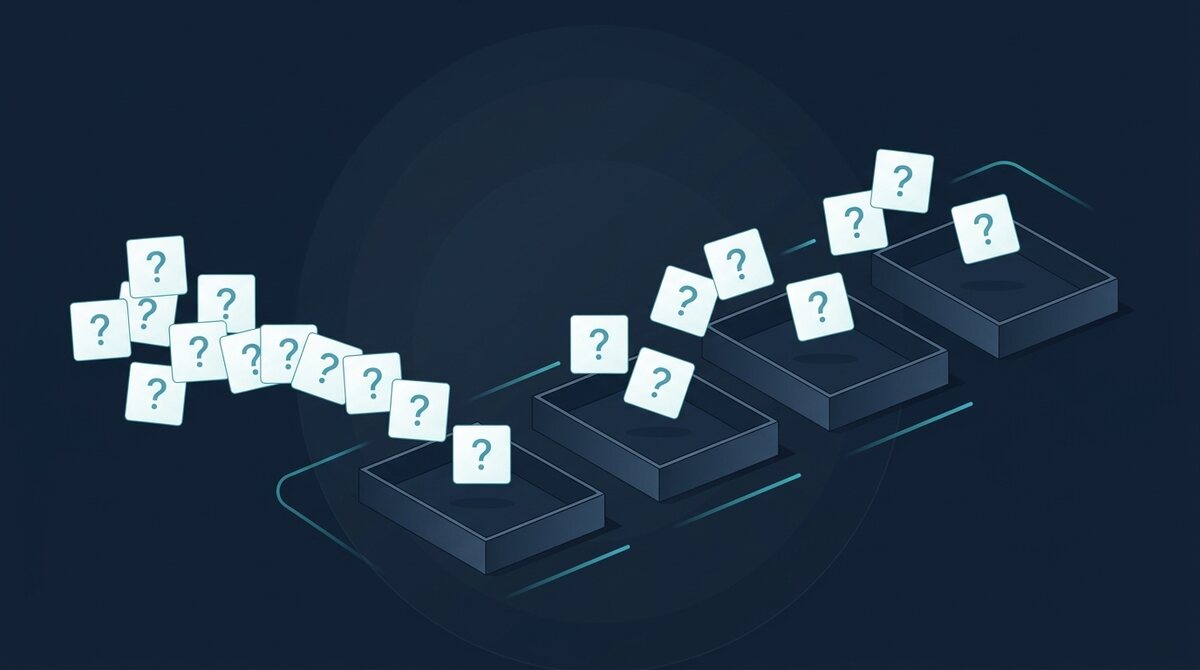
The five-phase arc above is the order to ask in. Some teams want the same questions sorted by the stage of the buying process they investigate, because that is how the findings get filed: awareness problems go to marketing, consideration problems to product marketing, decision problems to sales. Copy this block into your interview doc or CRM template.
WIN/LOSS INTERVIEW QUESTION BANK

AWARENESS (how they found the category and the shortlist)
  1. What was going on in the business that kicked off this evaluation?
  4. What did you type into Google, or ask an AI tool, when you started looking?
  5. Which vendors made the shortlist, and who got cut early? Why them?
  7. What almost stopped the whole project?

CONSIDERATION (how they compared options)
  3. Walk me through the evaluation from first search to signature.
  8. How did the other vendor describe us?
  9. What did they show you in the demo that stuck?
 10. Where did we look weakest next to them?
 11. What did you believe about us going in, and did it hold up?
 12. If both products had been identical, who wins, and why?

DECISION (what actually closed it)
  2. Who else was involved in the decision, and what did each of them care about?
  6. Was there a moment the decision effectively got made, before the official decision?
 13. How did the pricing conversations actually go, with us and with them?
 14. Was the price difference decisive, or was it cover for something else?
 15. Where in our process did you find yourself waiting or confused?
 16. What did procurement or legal say about each option?
 17. What would we have needed to change to win? (wins: What nearly lost us this?)

POST-DECISION (what to do with the answer)
 18. What advice would you give the next buyer evaluating this category?
 19. Six months from now, what will tell you whether you made the right call?
 20. What should I have asked that I didn't?

FILE EACH ANSWER UNDER: loss/win reason category - battlecard block -
pricing log - process fix - positioning note
The five-question survey version
Not every buyer will take a thirty-minute call. For the ones who will not, a survey gets a thinner but still useful answer, provided it stays short and open-ended. Five questions, free-text, no rating scales:
- What was going on in the business that started this evaluation?
- Which vendors did you seriously consider, and what put each on the list?
- What was the single biggest factor in the final decision?
- Where did we look weakest compared with the vendor you chose (or, if you chose us, what nearly lost us the deal)?
- What advice would you give the next buyer evaluating this category?
Send it from a person, not a marketing tool, within a week of the decision, and expect a response rate well under half. The survey is a supplement. Interviews are where the honest answers live, which is why the arc above exists.
What a good answer sounds like
The difference between a polite loss reason and a real one is usually one follow-up question. Here is how question 14 tends to play out, written as an illustration rather than a transcript of any specific customer:
Interviewer: How did the pricing conversations actually go, with us and with the vendor you chose?
Buyer: Yours came in higher. That was probably the main thing.
Interviewer: Was the price difference decisive, or was it cover for something else?
Buyer: Honestly, if the security review had gone faster we would have found the budget. We were waiting three weeks on your questionnaire and their rep had already gotten our IT lead on a call.
The CRM loss reason for that deal says "price." The interview says "security review turnaround and follow-up speed," which is a fixable process problem and a battlecard line about the competitor's sales motion. Log both. The pattern to watch for across interviews is the first answer being a category (price, timing, features) and the second answer being a story; it is the story that goes on the battlecard.
After the call: make the answers do work
An interview that ends in a doc nobody opens is the win/loss version of the 40-page teardown. Within a day: tag the loss or win reason against your standing categories, move quotable lines to the relevant battlecard blocks (Q8 and Q10 especially), and log pricing intel in the competitor's change log. Patterns across five or more interviews, not any single answer, are what justify a positioning or roadmap change. The win/loss playbook covers the synthesis loop.
Where tooling fits
Interviews are the depth layer; your recorded sales calls are the breadth layer, and buyers repeat most of the answers above inside live deals without being asked. KeystoneIQ flags competitor mentions in your synced Gong calls and lands them on the deal page, and on the Growth plan its win/loss pattern synthesis pulls recurring reasons across deals so your five interviews sit on top of evidence from fifty calls. The interview still gets you what no transcript contains, the buyer's after-the-fact honesty. The tooling makes sure you interview about the right pattern.
Frequently asked questions
How many win/loss interviews do I need before the findings mean anything?
Treat five as the floor before acting on a pattern, and weight recency. One interview is an anecdote; the value shows up when the same unprompted reason appears across several buyers who never met each other.
Should wins be interviewed too, or just losses?
Both, roughly balanced. Losses tell you what to fix; wins tell you what to protect and what to say louder. Win interviews are also easier to book, which makes them the right place to practice the arc.
Who should conduct the win/loss interview?
Anyone except the AE who ran the deal: a PMM, a founder, or a third party. The buyer's honesty is inversely proportional to how awkward the truth is for the person asking, and it is most awkward with the rep they turned down.
How long should a win/loss interview be?
Thirty minutes, scheduled as thirty, run as the five-phase arc above. Ten-minute calls only collect the polite answers, and sixty-minute asks depress your booking rate more than they add insight.
Should a third party run win/loss interviews?
It helps when the honest answer is awkward for anyone inside the company to hear, or when you need volume across many deals. Buyers tend to be more candid with an outsider, which is why win/loss research firms exist. For a team doing five to ten interviews a quarter, a PMM or founder using the arc above gets most of the benefit at no cost; the rule that matters is that the AE who ran the deal never conducts it.
Win/loss interview or survey: which should I use?
Both, in that order of priority. Interviews for the deals that matter (large, strategic, or a pattern you are trying to confirm); the five-question survey for everyone who declines the call. A survey alone collects the polite answers, because there is no follow-up question to get past them.
What are good win/loss survey questions?
Open-ended and few. The five-question version above is the whole survey. Rating scales ("how would you rate our pricing, 1 to 5") produce numbers that feel rigorous and explain nothing; a free-text "what was the single biggest factor" tells you what to change.
What tools help run win/loss analysis every week?
Your CRM, for tagging every closed deal with a competitor and a reason category; your call recorder, because buyers state most of these answers inside live deals before you ever interview them; and a place where the findings land on the battlecard rather than in a report. KeystoneIQ flags competitor mentions in synced Gong calls and, on the Growth plan, synthesizes win/loss patterns from closed CRM deals. The analyst-free win/loss playbook covers the weekly loop, and mining sales calls for competitive intelligence covers the breadth layer.
See KeystoneIQ in your stack
Built for modern PMM and GTM teams. No credit card, no annual contract. Your next brief in minutes, not weekends.
Start free, no credit card