Somewhere in your company today, a rep typed a competitor's name into Claude or ChatGPT and asked how to beat them. The answer came back fluent, confident, and assembled from whatever the model last saw on the open web: a pricing page from two years ago, a review that was about a different product, a feature the competitor deprecated. The rep used it on a call. This is the problem an MCP context layer exists to solve, and this post explains what one is, what it should expose, what to look for when a vendor offers one, and how to connect a competitive intelligence workspace to your assistant in about ten minutes.
What MCP is, in one paragraph
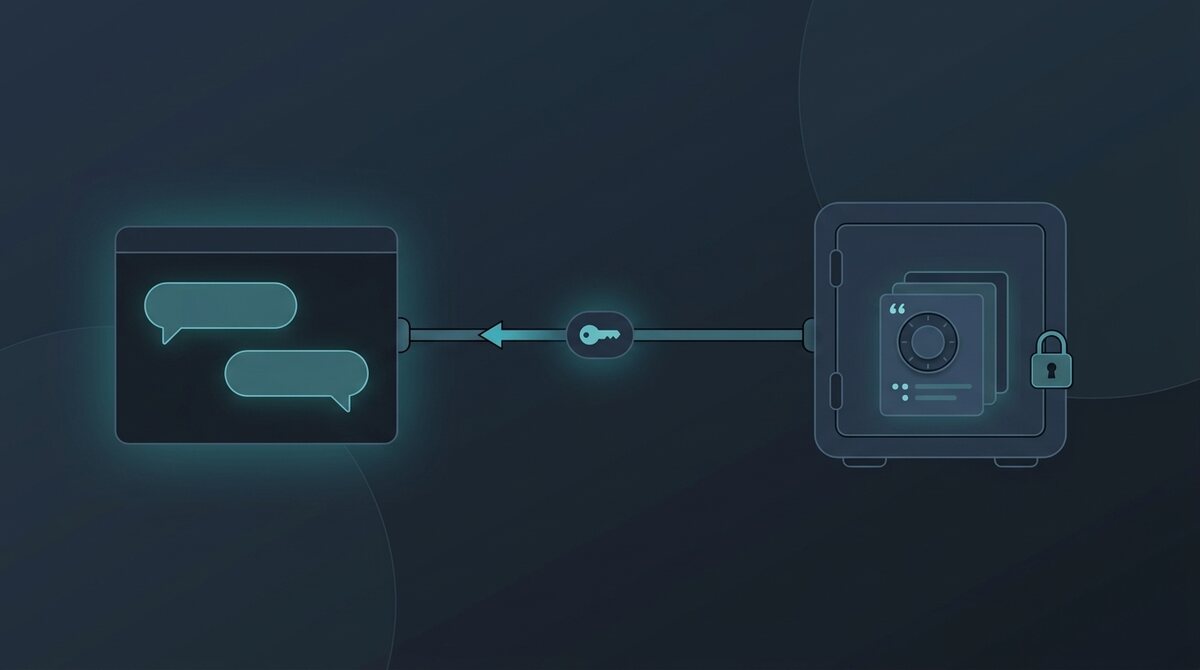
The Model Context Protocol is an open standard for connecting AI applications to external systems. Its own documentation describes it as "a USB-C port for AI applications": an assistant such as Claude, ChatGPT, Cursor, or Windsurf connects to a server once, and from then on the assistant can call that server's tools to read data or take actions. A competitive intelligence platform that ships an MCP server is therefore letting your assistant read your workspace, in your assistant's own interface, instead of you copying and pasting battlecards into a chat window.
Why the ungrounded assistant is a liability for competitive work
General assistants are good at prose and bad at provenance. Asked about a competitor, they produce an answer without a source, a date, or a way to tell which part is remembered and which part is invented. Competitive claims are exactly the kind of fact that changes quarterly and costs a deal when wrong: a price, a plan limit, a feature, a customer logo. The fix is not a better prompt. It is giving the assistant something verified to read, and making it show where each claim came from. That is the whole job of a context layer: the intelligence lives in a governed workspace with citations and dates, and the assistant reads it through a narrow, logged interface.
What a CI context layer should expose
Here is what the KeystoneIQ Context Layer serves, as a concrete example of the shape. It is a read-only MCP server with nine tools, and the full reference is in the docs.
| Tool | What the assistant gets | Plan |
|---|---|---|
list_competitors | The competitors the workspace tracks, so the assistant learns valid names before asking for anything else | Starter+ |
search_intelligence | Semantic plus keyword search over the verified corpus: competitor sites, news, reviews, call mentions, filings, uploaded documents. Each result carries source type, timestamp, corroboration count, and freshness | Starter+ |
get_latest_brief | The most recent weekly brief, with citation markers | Starter+ |
get_brief | One brief by id: weekly, deal, deep-research, or meeting brief | Starter+ |
get_facts | One current value per attribute for a competitor (pricing, headcount, funding, ratings, filings) with effective date, confidence, corroboration, and any open conflicts between sources | Starter+ |
get_battlecard | The live battlecard: positioning, strengths and weaknesses, objection handling, talking points, threat score | Growth+ |
get_threat_assessment | Current 0 to 100 threat scores and momentum for every tracked competitor | Growth+ |
get_positioning | The team's approved messaging framework, with each "why us" claim labelled as backed by evidence or the team's own call. Drafts are never served | Growth+ |
get_deal_context | CRM-fused context for one deal: stage, linked competitors, latest deal brief with talk tracks | Growth+ |
Three design choices in that list matter more than the tool count. The facts tool returns a confidence and a corroboration count with every value, and surfaces conflicts between sources rather than picking one silently, which is what lets the assistant say "two sources disagree on this price" instead of asserting one. The positioning tool labels every differentiator by how it was verified, so a rep asking "why do we win against X" gets a claim marked backed or marked team call, never an unlabelled one. And every response carries a provenance object that frames crawled third-party text as data rather than instructions, which reduces the risk of a competitor's website prompt-injecting your assistant.
Five things to ask once it is connected
The fastest way to understand the value is to run these in the first ten minutes. Each one is a question a PMM or rep would otherwise answer by opening four tabs.
- "What changed at [competitor] this week, and what should our rep say about it on a call?" The assistant reads the latest brief and the battlecard, and answers with the citations attached.
- "Compare [competitor A] and [competitor B] pricing, and tell me which values you are confident in." Two facts calls; the confidence and corroboration fields do the honest part.
- "I have a call with [deal] in an hour. Who are we up against and what are the talk tracks?" One deal-context call on Growth, which replaces the pre-call scramble.
- "Draft a launch email for [product]. Only use approved claims, and tell me which ones are backed." The positioning tool returns the framework with labels, so the draft cannot invent a differentiator.
- "Which competitor's threat score rose most this quarter, and why?" Threat assessment plus a search over the corpus for the driving signals.
Notice what these have in common: none of them asks the assistant to know anything. They ask it to read, compare, and draft from things that were verified before it arrived.
The ten-minute setup
The KeystoneIQ endpoint is https://keystoneiq.ai/api/mcp, and it speaks MCP over streamable HTTP with a workspace API key as a bearer token. Keys are created on the Developer page by a workspace owner and shown once. In Claude Code it is one command:
claude mcp add --transport http keystoneiq https://keystoneiq.ai/api/mcp \
  --header "Authorization: Bearer sk_YOUR_API_KEY"
In Cursor it is a short block in ~/.cursor/mcp.json, and Cursor expands environment variables in headers so a project file never has to contain the key itself:
{
  "mcpServers": {
    "keystoneiq": {
      "url": "https://keystoneiq.ai/api/mcp",
      "headers": { "Authorization": "Bearer ${env:KIQ_API_KEY}" }
    }
  }
}
Claude Desktop's connector UI accepts only OAuth servers, so it goes through the open-source mcp-remote bridge; the docs carry the exact config. Send no key at all and the server answers from a read-only sample workspace, which is the quickest way to see the tools before creating an account. Starter includes 300 tool calls a month, Growth 3,000, Pro unmetered; listing tools and initializing are free, and a tool your plan does not include answers with an upgrade note instead of an error, so the assistant can tell you what to do next.
What to look for when a vendor offers an MCP server
KeystoneIQ is not the only competitive intelligence platform with one. Crayon announced its MCP server and content APIs in October 2025 and describes itself as the first CI platform to do so, naming ChatGPT, Claude, Microsoft Copilot, and Glean as targets. Klue followed in December 2025 with a server it says was tested across OpenAI's Agent Builder, Copilot Studio, Claude Desktop, and enterprise LLM stacks, and which allows write-back: agent workflows can create and update Klue cards. Beyond the platforms there are scraper-style servers and Claude Code skills on marketplaces such as Apify and mcpmarket.com that build battlecards from public pages on demand.
Which is the right one depends on questions that have nothing to do with the protocol:
- Read-only or write-back? Write-back lets an agent update your battlecards, which is powerful and also means an assistant can put an unverified claim into the source of truth. A read-only server cannot. Decide which failure you would rather explain to a sales leader.
- Does every served claim carry its evidence? The test is simple: ask the assistant for a competitor's price and see whether the answer includes a source, a date, and a confidence. A server that returns prose without provenance has moved the hallucination problem, not solved it.
- Are approved messaging and drafts kept apart? If the server can hand the assistant a draft positioning doc, the assistant will use it as if it were approved. Look for a server that serves only the approved version and labels each claim by how it was verified.
- Scraper or workspace? A scraper server fetches public pages when asked, which is useful for a first look and useless for the deal your rep is on right now, because nothing in it is your CRM, your calls, or your team's judgment. A workspace server reads what your program already verified.
- Who can get it, and at what price? Klue and Crayon offer theirs inside enterprise contracts that Vendr's marketplace data puts at a median of about $30,000 a year. KeystoneIQ's is included from the $149 a month Starter plan, with a sample workspace you can query before signing up. For a team of one PMM, that difference decides the question before any feature does.
Governance, or what the assistant cannot do
The reason to route an assistant through a context layer rather than a data export is control. In KeystoneIQ's case: every call is scoped to the workspace tied to the key, with no cross-workspace access; every call is written to the workspace's audit log with the tool name, timestamp, and status, visible to owners on the Developer page; the server does not send workspace data to any AI provider while serving a request (the one exception is the search tool, which sends only the query text to the embedding provider to compute a retrieval vector); and nothing the assistant does through the server changes data in the workspace, because there are no write tools. What your AI client and its model provider do with a response is governed by their terms, which is worth reading before you connect a workspace that contains CRM data. The security overview covers how connector access is logged and retained.
Give your assistant something verified to read
Add your competitors, get a cited brief within the hour, then connect Claude or Cursor with one command. 14-day trial on Growth-tier limits, no credit card, and the Context Layer is included from Starter.
Start 14-day free trialFrequently asked questions
What is an MCP server for competitive intelligence?
A server that speaks the Model Context Protocol and exposes a competitive intelligence workspace (briefs, battlecards, competitor facts, approved messaging) as tools an AI assistant can call. Once connected, Claude, Cursor, or any MCP client that supports streamable HTTP can answer competitor questions from your verified data instead of from the open web, with the sources attached.
Do Klue and Crayon have MCP servers?
Yes. Crayon announced an MCP server and content APIs in October 2025 and Klue announced its MCP server in December 2025, with write-back so agents can create and update cards. Both are offered inside their enterprise contracts. KeystoneIQ's Context Layer is read-only and included from the $149 a month Starter plan.
Can Claude read my battlecards?
Through an MCP server, yes. In KeystoneIQ, Claude Code connects with one command and Claude Desktop through the mcp-remote bridge; the battlecard, threat score, positioning, and deal-context tools are available on Growth and Pro, and briefs, facts, and search on Starter. Browser-hosted assistants that require OAuth, such as claude.ai on the web, are not supported in the current release.
Is it safe to connect an AI assistant to competitive and CRM data?
It is as safe as the server's design makes it. Look for read-only tools, per-workspace keys, an audit log of every call, and a statement of what the server sends to any third party. Then read your AI client's own data terms, because the response leaves the server and goes to that client. A read-only server cannot corrupt your source of truth even if the assistant is manipulated; a write-back server can.
How many calls does a team actually make?
Each of the five questions above is one to three tool calls, so a PMM asking ten such questions a week uses roughly 100 to 150 calls a month, inside Starter's 300. A team of five doing the same lands around 600, inside Growth's 3,000. Listing tools and initializing the connection do not count, and neither do calls that return an upgrade note.
Sources
- Model Context Protocol, "What is the Model Context Protocol?".
- KeystoneIQ, Context Layer (MCP) reference and Context Layer for AI assistants.
- Crayon, "Connecting Competitive Intel to Enterprise AI with API and MCP" (October 20, 2025).
- Klue, "Introducing Klue's MCP Server" (December 12, 2025).
- Vendr Marketplace, Klue and Crayon pricing data (re-checked 2026-09-14).
Information about Klue and Crayon comes from each vendor's public announcements as of September 2026. Plan names, limits, and prices for KeystoneIQ are as published on keystoneiq.ai on the date above.
See KeystoneIQ in your stack
Built for modern PMM and GTM teams. No credit card, no annual contract. Your next brief in minutes, not weekends.
Start free, no credit card