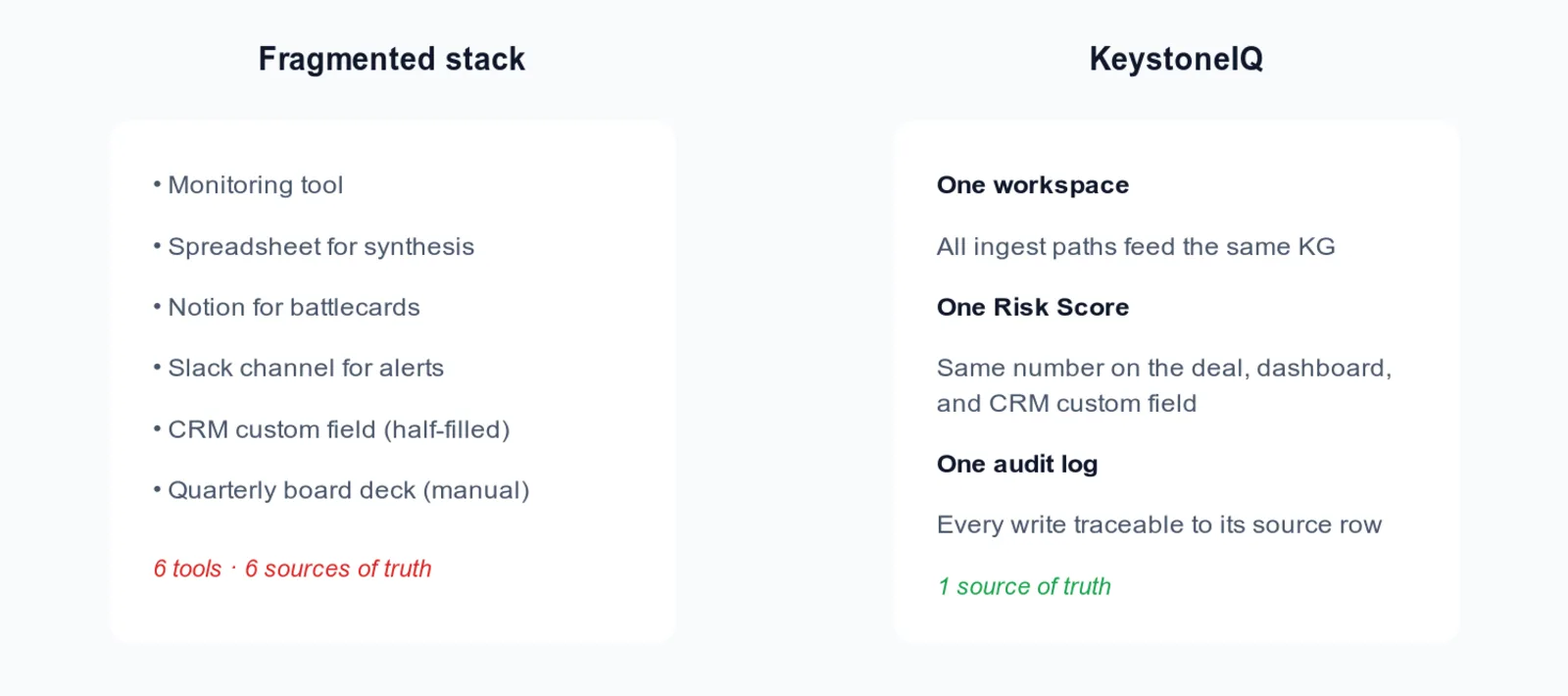
Most GTM teams that take competitive intelligence seriously end up with the same tangled stack. A monitoring tool watches the web. A separate scorer flags which signals matter. A spreadsheet (or Notion page, or Confluence) collects the analyst’s synthesis. A Slack channel routes alerts. The CRM has a custom field somebody half-fills. And every quarter, someone slides a board deck together by hand from all of the above. Six tools, six sources of truth, zero confidence the rep on the next call has the right context.
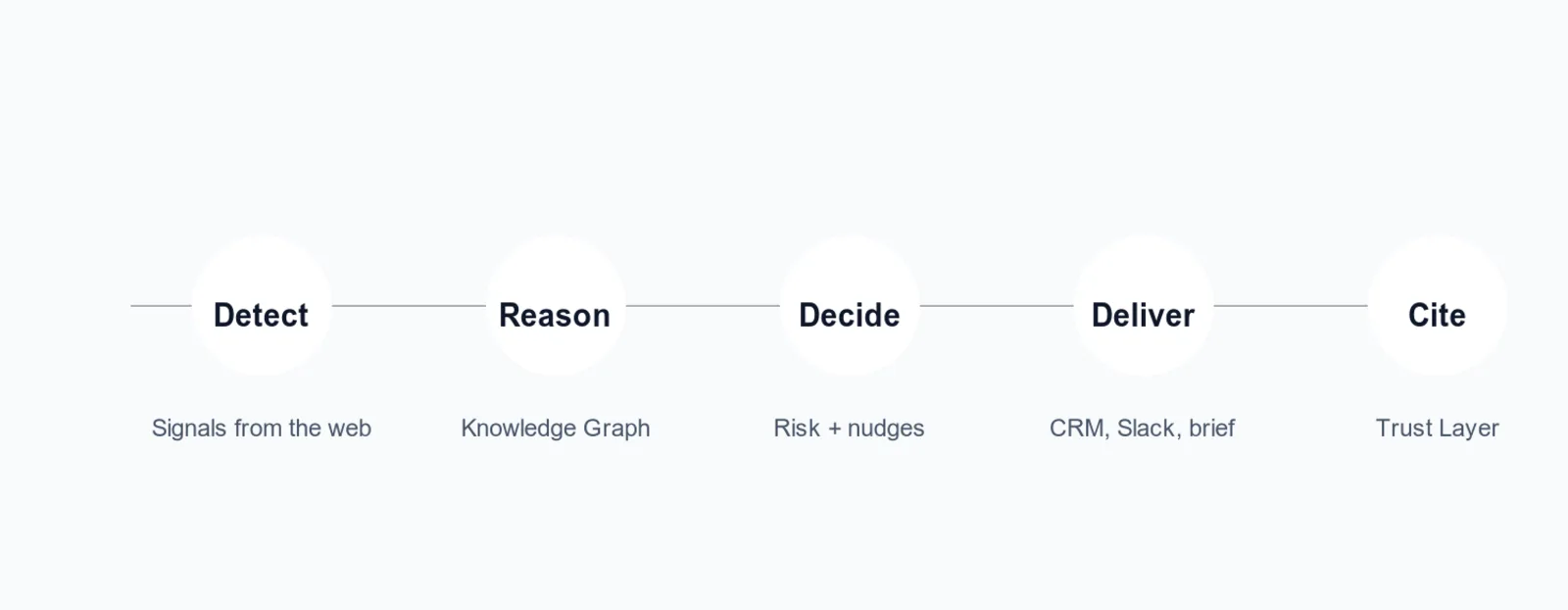
KeystoneIQ replaces that fragmentation with a single spine: detect → reason → decide → deliver → cite, end to end, on one product. This post is about why “unified” isn’t a marketing word for us — it’s an architectural commitment with concrete benefits in cost, audit, speed-to-value, and quality.
The cost of a fragmented stack
Pick any two tools that don’t share a data model and you’ve introduced a translation problem. Multiply that by six and you’ve introduced an integrity problem. The CRM thinks the deal’s competitor is “Vendor A.” The monitoring tool tracks “Vendor A, Inc.” The Slack channel mentions “A” as a nickname. The board deck shows whatever was true last Tuesday at 4pm.
The downstream pain isn’t any single bug — it’s the slow erosion of trust. Reps stop checking the brief because last week’s brief had a number nobody could defend. Sales ops stops filtering on the risk field because the field gets stale. The CRO stops asking “what’s our exposure on the X account” because the answer takes a week.
What “unified” actually means in our architecture
One workspace. One Knowledge Graph. One audit log. One billing surface. One integration to grant access to. Concretely:
- One ingestion path. Web crawl, news, public filings, GitHub releases, status pages, Reddit via its official API, G2 reviews via the G2 API with your own key, your CRM, your Google Drive — all land in the same intelligence stream with consistent typing and citation.
- One reasoning layer. The Knowledge Graph reconciles every signal into a single structured representation per competitor. The brief generator, the deal-risk scorer, the Generative Grid, and Ask KIQ all read from the same graph.
- One decision surface. Deal Risk Score is computed from the same components everywhere it appears: in the per-deal pane, in the pipeline dashboard, on the CRM custom field. There is no separate “CRM-only” or “dashboard-only” risk number.
- One delivery surface. Briefs render the same intelligence in HTML, in Slack, in HubSpot DealBriefCard, in the Salesforce sidebar, and in the upcoming Pro board report. Same source rows. Same citations. Same trust score.
- One audit log. Every write to your CRM, every Slack alert sent, every brief generated lands in the Governance dashboard with timestamp, actor, and source row references.
This is the structural difference from a stack of bolt-on tools. The point isn’t that we have more features — the point is that the features share a backbone, so the value compounds instead of fragmenting.
What changes when the spine is unified
1. The same number means the same thing everywhere
A unified Risk Score is not a small win. When the rep sees “HIGH” on the deal in HubSpot, sales ops sees the same “HIGH” in the Pro pipeline dashboard, and the CRO sees the same “HIGH” in the board report. There’s no “wait, why does the dashboard say MEDIUM but the deal says HIGH” conversation. The number is computed once, in the unified reasoning layer, and surfaced everywhere.
2. The audit trail is not 6 audit trails
When the legal team or the CRO asks “where did this competitive claim come from,” the answer is two clicks: open the brief, click the citation chip, see the source row with timestamp + URL + classification. There is no “let me check the monitoring tool… and the CRM logs… and the Slack channel….”
3. New surfaces ship in days, not quarters
Generative Grid (Pro), the Salesforce sidebar widget (Pro), and the GitHub / status-page / Reddit signal sources (Growth+) all shipped in one sprint. They didn’t require six new integrations on the customer’s side — they extended the same spine. When the next surface ships (the Pro board report’s quarter-over-quarter narrative, or a new ingest source), it inherits the same authn, the same citation model, the same audit log, the same Trust Score. Marginal cost of a new surface is days, not weeks.
4. One vendor decision, not six
Procurement teams hate stack sprawl. Each net-new vendor is a security review, a DPA, a SOC 2 attestation, a billing relationship, an integration owner. KeystoneIQ replaces six of those line items with one. That is the consolidation case we make once the initial competitive question is answered: the ROI conversation can broaden from “we needed competitive intel” to “we eliminated four vendor renewals.”
What it means by tier
- Free
- 14-day Growth trial. The unified spine in your stack at no cost, no card. After trial: 1 competitor, basic intel stream, brief refreshes.
- Starter ($149/mo)
- The detect-and-deliver core: weekly briefs, intel stream, CRM sync, Slack delivery, Gong call-flagging. The unified spine for one product’s competitive surface area.
- Growth ($399/mo)
- The full reasoning layer: Knowledge Graph, Ask KIQ, Deal Risk Score, live deal nudges, bi-directional CRM write-back, GitHub + Reddit + status-page signals, persona-aware nudges across PMM, AE, Enablement, Strategy, CI, and the C-suite.
- Pro ($799/mo)
- The executive intelligence stack: Generative Grid, Salesforce sidebar widget, board / exec report generator, SEC EDGAR financials, pricing impact analysis, multi-workspace organizations, custom brief branding.
What it doesn’t replace
Two honest exclusions. KeystoneIQ is not a CRM — we write to your CRM but we don’t replace it. And KeystoneIQ is not a marketing automation platform — we feed insights into your campaigns but we don’t run them. The spine is built around the competitive intelligence job-to-be-done; it integrates outward to the systems that already own the work around that job.
Frequently asked
- What does “unified” actually mean technically?
- One workspace, one Knowledge Graph, one audit log, one billing surface. Every signal lands in the same intelligence stream with consistent typing and citation. Every downstream surface (briefs, scoring, Slack, CRM, board reports) reads from the same backbone, so the same Risk Score on a deal in HubSpot is the same number in the pipeline dashboard and the board report.
- How is this different from buying a monitoring tool plus a battlecard tool plus a CRM enrichment tool?
- A stack of three tools means three sources of truth, three sets of credentials, three audit logs, three billing relationships. Each tool is a translation boundary where data drifts. KeystoneIQ collapses that into one spine, so a competitor’s pricing change detected this morning is reflected in the brief, the deal-risk score, the CRM field, and the next board-report draft without anyone copy-pasting.
- Do I have to use every surface to get value?
- No. A common starting point is weekly briefs + Slack delivery, adding the CRM write-back, Ask KIQ, or Generative Grid later. The point of one spine is that adding a new surface doesn’t require a new integration — it’s a checkbox in the workspace.
- What about agency users or multi-brand teams?
- Pro supports multi-workspace organizations (up to 5 workspaces) with custom brief branding per workspace. Each workspace has its own competitor set, its own Knowledge Graph, its own audit log — the unified spine extends per-workspace rather than blurring across.
- What does the Trust Layer guarantee?
- Every claim in a brief carries a ClaimChip citation back to the source row. Every source row has a classification (web page, news article, public filing, review, social, your CRM, etc.) and a timestamp. The Governance dashboard shows the audit trail of every CRM write and Slack alert. The Trust Score per brief is computed from groundedness + intra-corpus consistency, not opinion.
- How fast can I see this work end-to-end?
- Your first brief typically lands in under 30 minutes from signup. The 14-day Growth trial gives full access so you can evaluate the spine end-to-end — CRM write-back, Slack delivery, Ask KIQ, Risk Score — before paying.
See KeystoneIQ in your stack
Built for modern PMM and GTM teams. No credit card, no annual contract. Your next brief in minutes, not weekends.
Start free, no credit card