Let's start with the part most "alternatives" posts skip: Crayon is a good product. It holds a 4.6/5 rating across 385 reviews on G2 (checked October 4, 2026), monitors a wide sweep of competitor signals, and its battlecard and sales-enablement workflows are genuinely mature. If you have a dedicated competitive intelligence function, a large rep org to enable, and the budget and procurement bandwidth for an annual enterprise contract, Crayon may simply be the right call, and you can stop reading here.
Also in this series: Klue alternatives · Kompyte alternatives · KeystoneIQ vs Klue, Crayon, and Kompyte · Klue vs Crayon head-to-head
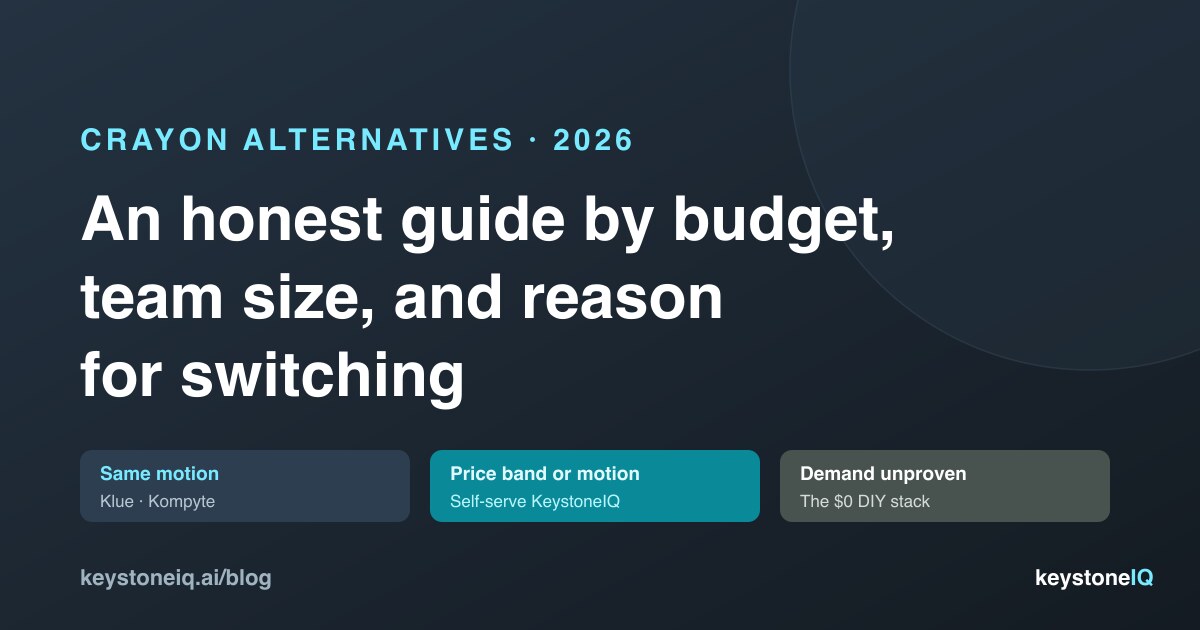
This guide is for everyone else: the teams typing "crayon alternatives" into a search bar because the price band does not fit, the sales-led buying motion does not fit, or the CI program is one product marketer's Tuesday afternoon rather than a department. The right alternative depends almost entirely on which of those describes you, so this post is organized around the reason you are looking, not around a feature grid.
What Crayon actually costs, and how it is sold
Crayon does not publish pricing. Every contract is quoted through a sales process, and buyers typically move through a demo, a scoping conversation, and an annual (often multi-year) agreement.
The third-party data is reasonably consistent on what those quotes land at:
- Vendr's marketplace data, drawn from 93 recorded purchases, puts the median Crayon contract at about $30,000 per year, with typical deals ranging from roughly $12,700 on the low end to $46,000 on the high end, and enterprise deployments running into six figures (as of October 4, 2026).
- Prospeo's 2026 analysis frames the common band as $20K–$40K annually, with entry points around $25K+, contracts sized mainly by how many competitors you track rather than by seats, and implementation taking about a month.
Two structural notes matter for budgeting. First, because Crayon prices on competitor coverage rather than seats, enabling a large sales team is comparatively cheap, which is a genuine advantage for enterprise buyers. Second, per Vendr, multi-year commitments are how buyers get the effective annual price down, which means the cheapest path is also the longest lock-in.
Why teams go looking for an alternative
Reading through public reviews on G2 and third-party roundups, the recurring reasons are not really about product quality. They cluster into four buckets:
- The price band. A $25K–$40K line item is a CFO conversation. For a 200-person company with one PMM, it is often the marketing-tools conversation for the quarter.
- The buying motion. No public pricing, no self-serve signup, no free trial: evaluation runs on the vendor's timeline, through demos and procurement, before you see your own competitors in the product.
- The curation burden. The critical theme Prospeo's roundup leads with is signal-to-noise: Crayon's breadth of monitoring means feeds need what one Capterra reviewer, quoted by Prospeo, called "highly manual daily curation." Prospeo's view is that without someone who owns CI as a real responsibility, alerts pile up and reps tune out. This is less a flaw than a design assumption: the platform assumes a curator exists.
- Program shape. Related to the above, enterprise CI platforms assume competitive intelligence is somebody's job. If it is two to four hours of one person's week, most of the platform's surface goes unused while the invoice does not shrink to match.
A couple of narrower complaints also show up in reviews worth knowing about if they touch your stack: Prospeo's 2026 roundup reports no native mobile app and says the revenue-impact module depends on Salesforce, which Prospeo notes limits that module for HubSpot or Dynamics shops.
Crayon is right for you if: you have (or are hiring) a dedicated CI owner, a rep org of 50+ to enable, Salesforce as your CRM, and an approved five-figure budget with procurement capacity for an annual contract. If that is you, run a Crayon-vs-Klue bake-off and skip the rest of this list.
The alternatives, sorted by why you are looking
If you want the same enterprise motion from a different vendor: Klue
Klue is Crayon's closest peer: an enterprise CI platform with battlecards, intel feeds, win-loss, and a sales-led motion. Choosing between them is a workflow-fit decision, not a budget escape: Vendr's data on Klue (106 recorded purchases) shows a median contract of about $30,000 per year, identical to Crayon's median, with typical deals between $16,000 and $60,000 (as of October 4, 2026), priced per user across Essentials, Professional, and Enterprise tiers.
The practical difference for buyers: Klue prices primarily on seats, Crayon primarily on competitor coverage. If you need to enable a huge rep org against a handful of competitors, Crayon's model tends to work in your favor; if a small team tracks many competitors, Klue's can. Either way you are running the same procurement process. We wrote a full companion piece on this branch: Klue Alternatives in 2026.
Trade-off: you solve vendor preference, not price band or motion.
If you want enterprise CI at (reportedly) a lower quote, with an asterisk: Kompyte
Kompyte covers similar ground (automated competitor tracking, battlecards, sales enablement), and third-party writeups such as Parano.ai's pricing analysis (Parano.ai is itself a CI vendor) position it below Crayon and Klue at comparable deployment sizes; Kompyte has no Vendr median, so treat this as unverified. Like both of them, it publishes no pricing and sells through a demo-led sales process.
The asterisk is corporate: Kompyte has been part of Semrush since 2022, and Adobe completed its $1.9 billion acquisition of Semrush on April 28, 2026 (Adobe newsroom, Search Engine Journal). Adobe's stated rationale centers on SEO, generative-engine optimization, and brand visibility, not competitive intelligence. That does not mean Kompyte is going away; it does mean that if you are signing an annual contract in late 2026, it is fair to ask the sales team direct questions about the product's roadmap and where it sits in Adobe's portfolio.
Trade-off: potentially lower cost inside the same sales-led motion, with an ownership change (Adobe, April 2026) worth asking about.
If your real need is broader market intelligence, not deal support: Contify or AlphaSense
Some teams searching for Crayon alternatives discover mid-search that what they actually need is wider than competitor tracking.
Contify positions itself as a market and competitive intelligence (M&CI) platform: alongside competitors it monitors industry trends, key accounts, partners, and suppliers, drawing on what it describes as over a million vetted sources across 117+ languages, with its "Athena" AI layer on top. Contify's site publishes no pricing (checked October 4, 2026), though Contify does offer a 7-day free trial alongside its demo motion, which is unusual in this category. It is a fit for strategy and insights functions at larger organizations more than for a lean PMM team arming sales.
AlphaSense comes at intelligence from the research side: an AI search-and-summarization engine over filings, transcripts, expert calls, news, and broker research. It is a serious tool with serious pricing, though the public figures are total contract values rather than per-seat rates: Vendr reports a median of $18,375 per year across 40 recorded purchases, ranging from $9,750 to $51,300, while SpendHound, tracking 160 customers, puts the average SMB contract at $7,970 per year and the average enterprise contract at $120,645 (both checked October 4, 2026; SpendHound's page was last updated October 1, 2026). Licensing is seat-based and sold annually, but no per-seat rate is published, so the spread depends heavily on seat count and content tiers. If your questions sound like "what is happening in this market and what did management say on the earnings call," AlphaSense fits. If they sound like "what changed on the competitor's pricing page and what do I tell reps," it is the wrong shape.
Trade-off: broader intelligence, but you move further from, not closer to, the battlecard-and-deal-support workflow Crayon buyers usually want, and (for AlphaSense especially) further up the price band.
If price band and buying motion are the problem: KeystoneIQ
Full disclosure: this is us, so do not take our word for anything here. The product claims below are checkable in the free trial.
KeystoneIQ is built for the segment enterprise CI platforms are not: Frontier PMM and GTM teams who need the weekly CI workflow without a CI department. The relevant facts:
- Pricing is public and self-serve: a Free tier, then Starter at $149/mo, Growth at $399/mo, and Pro at $799/mo per workspace, or $1,490, $3,990, and $7,990 a year billed annually. Month to month is available: no annual contract required, no procurement process, no demo call to see a price.
- A 14-day free trial on Growth-tier limits, no credit card. Your real competitors, your first brief, before any buying conversation.
- The workflows overlap with what the enterprise platforms advertise: automated competitor monitoring, weekly AI-written competitive briefs (Starter and up), meeting briefs for upcoming CRM meetings, and, on Growth and Pro, per-competitor battlecards. One design choice is aimed at the curation problem above: key claims in a brief carry a citation linking back to the source, with how many sources agree, so a PMM (or a skeptical rep) can verify intel without a curator standing between the feed and the field.
- Integrations: Salesforce, HubSpot, Pipedrive, Zoho, Slack, and Gong, deliberately including the mid-market CRMs that some enterprise tools support less fully.
At the top of the range, Pro billed annually is $7,990 a year, against the $12.7K–$46K band Vendr reports for Crayon. Starter and Growth billed annually are $1,490 and $3,990 a year.
What you give up is real, and you should weigh it honestly: no dedicated customer success team building your program for you, no analyst services layer, no seat-heavy enterprise enablement machinery, and a younger product than a category leader. Our claim-by-claim buyer's guide makes the detailed comparison with sources, and the sample reports show the actual artifacts.
Trade-off: no enterprise services layer, in exchange for a price and motion sized to a lean team.
If you have not proven CI demand yet: the DIY stack
If you are not sure competitive intelligence earns a line item at all, do not buy anything, including from us. Run Google Alerts, a shared notes doc, and a monthly manual pricing-page check for one quarter. It costs $0 in software and a few hours a month, and it answers the only question that matters: does anyone consume this? If sales quotes your intel in deals and leadership asks for the next brief, you have proven demand and can pick a paid tier with evidence. If nobody reads it, you just avoided a five-figure mistake. Our field guide to CI tools by team size and budget covers how to graduate from the DIY stack when the time comes.
The shortlist at a glance
| Option | Reported price band | Buying motion | Best fit |
|---|---|---|---|
| Crayon | ~$12.7K–$46K/yr typical, median ~$30K (Vendr, Oct 2026) | Sales-led, annual | Enterprise GTM with a dedicated CI owner |
| Klue | $16K–$60K/yr typical, median ~$30K (Vendr, Oct 2026) | Sales-led, annual | Same segment, per-seat pricing model |
| Kompyte (Semrush/Adobe) | Unpublished; positioned below Crayon/Klue by Parano.ai, itself a CI vendor (unverified) | Sales-led, annual | Enterprise CI on a tighter quote; ask about roadmap |
| Contify | Not published (contify.com, Oct 2026) | Demo-led; 7-day trial | Broader market & account intelligence at larger orgs |
| AlphaSense | Median ~$18.4K/yr, $9.75K–$51.3K (Vendr); SMB avg ~$8K, enterprise avg ~$121K (SpendHound), Oct 2026 | Sales-led, annual | Market/financial research, not deal support |
| KeystoneIQ | Free; $149 / $399 / $799 per month, or $1,490 / $3,990 / $7,990 billed annually | Self-serve, monthly or annual, 14-day free trial | Frontier PMM and GTM teams without a CI department |
| DIY stack | $0 + your hours | None | Proving CI demand before buying anything |
Pricing for sales-led vendors is third-party marketplace data, not list pricing. Treat it as a starting point and verify with each vendor.
The two-week test that settles it
Whichever branch you take, the evaluation is the same:
- Load your real competitors: the three to five you actually win and lose against, not the aspirational list of twelve.
- Connect the surfaces your team lives in: CRM, Slack, call recordings.
- Judge exactly one thing: within 14 days, did the tool change something live (a deal call, a positioning decision, a battlecard a rep actually opened)? Intelligence that never reaches a decision is research theater at any price.
The enterprise vendors will run this with you as a guided pilot on their timeline. KeystoneIQ's version is a self-serve 14-day trial on Growth-tier limits, no credit card. Run whichever fits your motion, but insist on your real competitors and your real deals either way.
Frequently asked questions
What is the best alternative to Crayon?
It depends on why you are switching. If you want the same enterprise platform category from a different vendor, Klue is the closest peer, and third-party writeups position Kompyte lower (unverified). If your need is broader market intelligence, look at Contify or AlphaSense. If Crayon's price band or sales-led motion is the problem, a self-serve platform like KeystoneIQ covers the weekly CI workflow with a Free plan and paid plans at $149–$799 per month. If you have not proven internal demand for CI, start with a free DIY stack.
How much does Crayon cost?
Crayon does not publish pricing. Third-party marketplace data from Vendr, based on 93 recorded purchases, shows a median contract of about $30,000 per year, with typical deals ranging from roughly $12,700 to $46,000 and enterprise deployments exceeding $100,000 (as of October 4, 2026). Contracts are sized mainly by competitor coverage and are usually annual or multi-year. Verify current numbers directly with Crayon.
Is there a free alternative to Crayon?
No free tool replicates an enterprise CI platform. What exists free is the DIY stack (Google Alerts, manual pricing checks, review-site browsing, and a disciplined change log), plus free tiers of self-serve tools (KeystoneIQ's Free tier covers one competitor). Free approaches cost hours instead of dollars and decay without an owner, but they are the honest way to prove CI matters before paying for it.
Do I need a dedicated CI person to get value from a Crayon alternative?
For Crayon, Klue, or Kompyte, realistically yes: all three are sold and priced for programs with a dedicated owner, and the reviews and roundups cited above describe the curation load that follows. Self-serve tools aimed at lean teams are designed around the opposite assumption: that CI is a few hours of one person's week, so the product has to do the filtering and citing itself. Match the tool's assumed staffing to your actual staffing before you match features.
Information about Crayon, Klue, Kompyte, Contify, and AlphaSense comes from each vendor's public pages, third-party marketplace data (Vendr, Prospeo, SpendHound, Capterra), public review aggregates (G2), and public announcements. Vendor pages, Vendr, SpendHound, Prospeo, and Parano.ai were re-checked on October 4, 2026; G2 and Capterra block automated checks, so the G2 rating is as reported by Prospeo. Vendor pricing and packaging change frequently, and quote-based pricing varies by deal. Treat every number here as a starting point and verify directly with the vendor before a procurement decision.
See KeystoneIQ in your stack
Built for Frontier PMM and GTM teams. No credit card, no annual contract. Your next brief in minutes, not weekends.
Start free, no credit card